

Composer Wolfgang Amadeus Mozart began writing ‘Requiem in D Minor’ in 1791, but died at 35 before it was completed. Part of that composition, called ‘Lacrimosa,’ are thought to be the last notes he wrote.
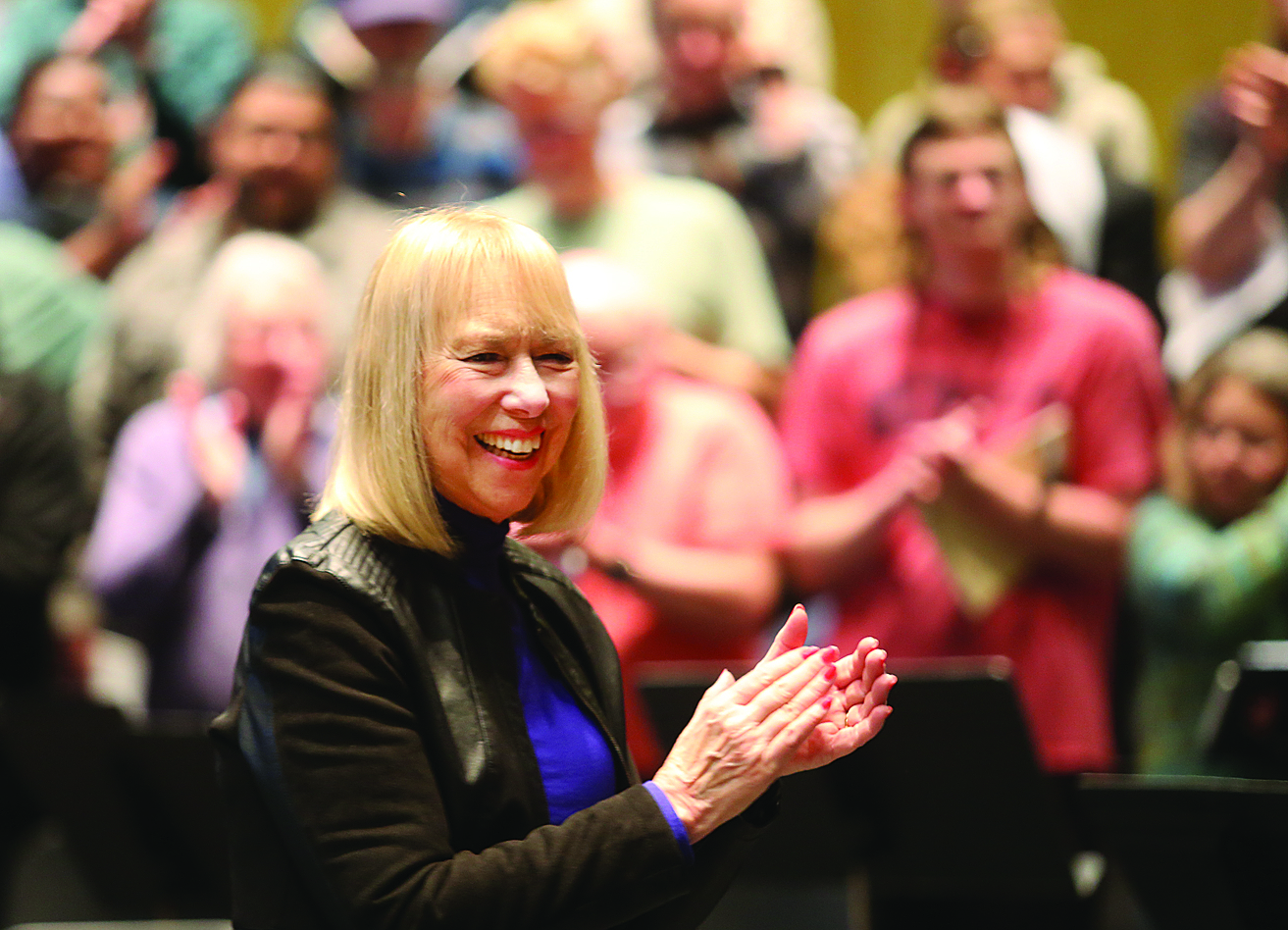
Perhaps it is fitting, then, that the Requiem will be the swan song of Cheryl Anderson, Cabrillo College’s director of Choral and Vocal Studies before her retirement at the end of the year, capping a 35-year career.
Anderson has made the institution a cornerstone of Santa Cruz County’s musical culture, a career that in 2018 earned her the County Artist of the Year award by the Santa Cruz County Arts Commission.
In her time at Cabrillo College, Cheryl founded the Cabrillo Youth Chorus (CYC), served as the Conductor of the Cabrillo Symphonic Chorus, Chorale and Cantiamo!, and was founder and artistic director of the Cabrillo Opera and the Conductor of Cabrillo Stage.
The Cabrillo choirs have performed at Carnegie Hall in New York City three times, most recently this past April, when they performed The Notebooks of Leonardo DaVinci, by Composer Jocelyn Hagen.
She worked with Cabrillo College to commission world-renowned composers to write works for the Cabrillo Choirs and CYC, who premiered them in performances locally and twice at Carnegie Hall.
Kirke Mechem, considered the ‘Dean of American Choral Music,’ requested that Anderson premiere his latest work—the opera ‘Befana’—a Christmas Fable which premiered at Cabrillo’s Crocker Theater in 2022.
“The gratitude I feel for the job I get to do each day is boundless,” Anderson stated in a press release. “I have been able to envision and breathe life into a program encompassing all ages and spanning the fullness of music which can be sung. Few musicians are able to realize that dream; working with the Cabrillo choruses and with the entire community has left me in a state of grace, gratitude, and fulfilling abundance.”
The Cabrillo Symphonic Chorus under the direction of Cheryl Anderson will perform Mozart’s Requiem with the Santa Cruz Symphony May 3 at the Santa Cruz Civic Auditorium and May 4 at the Mello Center in Watsonville. Tickets are still available for both performances.
•••
Performances
• Saturday, May 3 at the Santa Cruz Civic Auditorium, 7:30pm. (Pre-concert talk at 6:30pm)
• Sunday, May 4 at the Mello Center, Watsonville at 2pm. (pre-concert talk at 1pm)
For information, visit santacruzsymphony.org. For tickets, call 831.420.5260 or visit Santa Cruz Tickets











As someone who studied under Cheryl Anderson from 2011 to 2016 and a community member that grew up in Watsonville (EA Hall/Watsonville High C/o 2010), I feel compelled to add a perspective that is missing from this otherwise celebratory narrative.
What is presented publicly as dedication and excellence often came, in my experience, at the expense of student wellbeing. The environment fostered was NOT one of mentorship, but of control—where participation was not simply encouraged, but expected under implicit threat. I recall being told that a prior commitment preventing me from performing in a Cantiamo holiday concert could affect whether I would receive a letter of recommendation for college. Despite years of loyalty and contribution, that moment was not only disheartening, but deeply inappropriate.
The result of that kind of pressure is not excellence—it is fear. I, like others, reached a point where even singing felt fraught, where expression was replaced by anxiety about consequences. That is not what music education should be.
It is easy, in retirement, to highlight accolades and surface-level success stories. But a legacy is not only defined by programs built or concerts performed—it is defined by how students were treated in the process. Many of us carried forward not inspiration, but the need to rebuild confidence that was diminished in that vile environment.
I share this not out of bitterness, but because narratives like this are incomplete without acknowledging the experiences of those who were directly impacted. I sincerely hope future generations of students encounter leadership that values both artistic growth and personal dignity equally.
I would also add that my experience was not isolated. At the time, many of my classmates and colleagues shared these same sentiments quietly with one another. There was a kind of unspoken understanding, confirmed again and again in private conversations, that what we were experiencing did not align with the ideals of mentorship being described here. Still, very few felt safe naming it openly, given how much influence was tied to recommendations and future opportunities. Looking back now, I suspect many of these same individuals, now that we are adults established in our own careers, would be able to speak more freely about those experiences.
Reading language about “community,” “family,” and artistic fulfillment, I can’t help but notice how different that framing feels from what many of us experienced behind the scenes. When authority is paired with that level of personal and professional leverage, it creates an environment where compliance is mistaken for cohesion, and silence is mistaken for respect!
In terms of the “success stories” often associated with this program, I think it’s worth approaching that narrative with a degree of honesty. While many students remained connected to music in some capacity, very few followed the kind of international trajectory we were consistently told we were being prepared for. Dare I say promised? Many of Cheryl’s star pupils, stayed local teaching music to kids. Others moved into different facets of music or stepped away from music/performance altogether.
I made an effort in 2016 to bring my concerns forward through the appropriate Cabrillo administration channels, aka Dean John Graulty. That experience was very discouraging. It became clear that my concerns were not going to be meaningfully received, which only reinforced how difficult it was for students to advocate for themselves in that environment.
All of that said, I consider myself fortunate and Cheryl Anderson’s threat to blackmail me was the push I needed to leave her program. I was so lucky to have other mentors who showed me what real support and integrity look like, and they helped me regain my footing. With their guidance, and a lot of work on my own, I was able to move forward and ultimately earn admission to UC Berkeley on a full scholarship! That didn’t come from pressure or control. It came from being encouraged to grow. When I look back, that contrast stands out most. Leadership in the arts can either build confidence or wear it down. An emphasis on “aggressive excellence,” without care to balance it, can easily become something else. Music, at its best, holds the key to a brighter tomorrow. It should expand people, not make them smaller.
For many of us, that distinction was not always there, and instead we put our welling being at risk for the service of Cheryl’s name and her program. That is an important part of the story that deserves to be acknowledged alongside the one being told here.