
The Watsonville City Council on Feb. 10 reviewed a draft Vision Zero Corridor Study aimed at reducing traffic deaths and serious injuries, particularly among pedestrians and bicyclists.
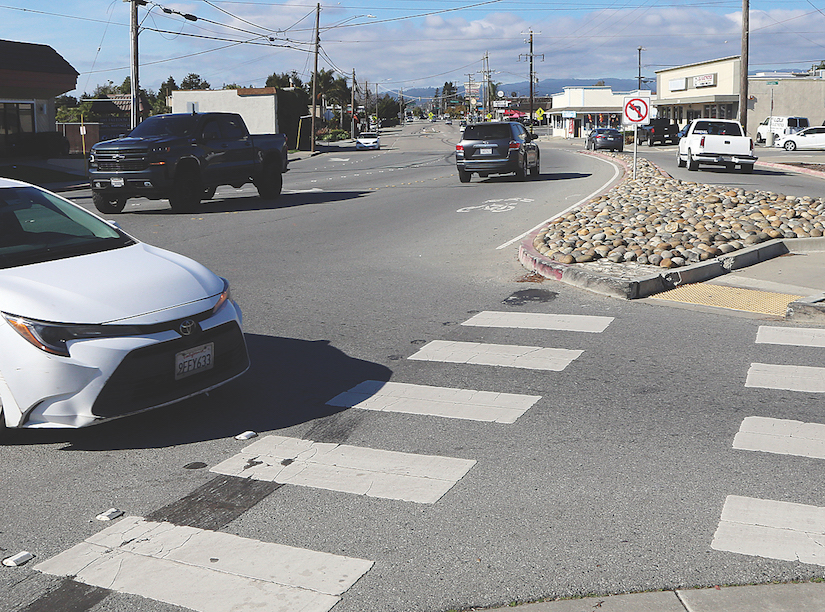
The proposal calls for several changes along Freedom Boulevard, including lane reductions, a traffic circle at Lincoln Street, improved crosswalks and bike lanes.
City officials describe traffic safety as an ongoing crisis. Between 2017 and 2022, Watsonville recorded 177 pedestrian crashes and 61 bicycle crashes resulting in death or serious injury. From 2019 to 2022, 13 people were killed in traffic collisions overall. Although walking and biking account for a small share of trips — about 3% of work commutes — pedestrians and cyclists make up 65% of those killed or seriously injured in crashes.
“If we keep our streets the way they are, we will keep our collision rates the way they are,” Watsonville Assistant Community Development Director Justin Meek said. “If we want to improve safety on city streets, we will need to make changes.”
Watsonville Principal Engineer Murray Fontes pointed to a California Office of Traffic Safety website (bit.ly/3ZN58vN) that ranks crashes among cities of similar size. According to the site, Watsonville ranked in the top 15 for pedestrian collisions between 2009 and 2023, he said.
The city adopted a Vision Zero policy in 2018 and a Vision Zero Action Plan in 2021, committing to eliminate traffic deaths and serious injuries by 2030 using a “Safe System” approach. The framework emphasizes managing vehicle speeds, reducing conflict points and designing streets to account for human error.
In 2023, Watsonville and Ecology Action secured a Caltrans Sustainable Transportation Planning Grant to conduct a corridor-level study building on the 2021 plan. Transportation consulting firm Fehr & Peers provided technical analysis.
The study evaluated six high-collision corridors—Airport Boulevard, East Lake Avenue, Freedom Boulevard, Green Valley Road, Main Street and Riverside Drive—based on crash history, roadway conditions, equity and feasibility.
Freedom Boulevard was selected for in-depth analysis because of its high rate of severe crashes, heavy traffic volumes of about 24,000 trips per day, wide right of way and limited pedestrian and bicycle infrastructure. The corridor is also identified in the draft General Plan 2050 as a priority area for infill housing and mixed-use development.
Between 2019 and 2023, Freedom Boulevard saw 109 collisions resulting in nonsevere injuries and nine crashes that caused death or serious injury. Fifteen percent of collisions involved bicyclists and 10% involved pedestrians. The most common contributing factors included right-of-way violations, unsafe speeds, driving under the influence and improper turning.
Community outreach took place between April and August 2025, with bilingual materials in English and Spanish. The process included workshops, pop-up events, bike audits, interviews and online surveys, drawing 413 participants.
Residents identified gaps in sidewalks, a lack of separation between travel modes, limited transit access and speeding as key concerns. When asked to weigh safety improvements against potential traffic delays, 77% of survey respondents said they prioritized pedestrian and bicyclist safety even if it meant slightly longer travel times.
Using crash data, public input and Safe System principles, the project team developed two design alternatives and a preferred concept combining elements of both. The recommended design includes continuous sidewalks, buffered bike lanes, lane narrowing, targeted lane reductions in constrained areas, enhanced crossings, protected intersections and other traffic-calming features. The goal is to create a “complete street” that supports walking, bicycling and transit while maintaining Freedom Boulevard’s role as a major north-south route.
The draft study was presented to the Planning Commission on Feb. 3 and was before the City Council for feedback. As a planning-level document, it does not authorize construction and is not subject to environmental review under the California Environmental Quality Act.
Council Member Casey Clark expressed concern that reducing lanes along the busy roadway would have a deleterious effect, slowing traffic and making it harder to reach businesses along Freedom Boulevard. He also said the plan does not address other areas of concern, including the Airport Boulevard intersection and the area in front of Freedom Centre.
“This essentially is going to punish the industries along that corridor,” he said. “It’s going to punish the businesses.”
Council Member Ari Parker called the proposal to narrow Freedom Boulevard leading into a traffic circle “scarier than heck,” saying it could push drivers onto alternative routes and shift traffic problems to other parts of the city.
“The concept of going from four lanes to two on Freedom Boulevard, I cannot support that,” Parker said.
Council Member Maria Orozco said the changes would be worth the investment because few people feel safe walking and biking along Freedom Boulevard.
“How do we expect folks to walk or bike more if we don’t have the infrastructure to encourage that?” Orozco said.The study is funded through the Caltrans grant and city staff support. The draft is available at bit.ly/4qFoSMN for public review through Feb. 27, with comments accepted online or by email. It is expected to be finalized by April.