
Questions on the human and environmental effects from the Moss Landing Battery Plant fire on the Jan. 17, 2025 are still being explored.
The March 17 Monterey County Board of Supervisors’ meeting contained an update on the progress of the cleanup, what some of the scientists are investigating and what they are discovering. There were four presentations that were followed by questions and comments.
The first two were by the California Department of Toxic Substance Control (DTSC). One was on the human risk and the second on was on the ecological risk. The final two presentations were by community groups, the Estuary Monitoring of Battery Emissions and Residues (EMBER), and Never Again Moss Landing (NAML).
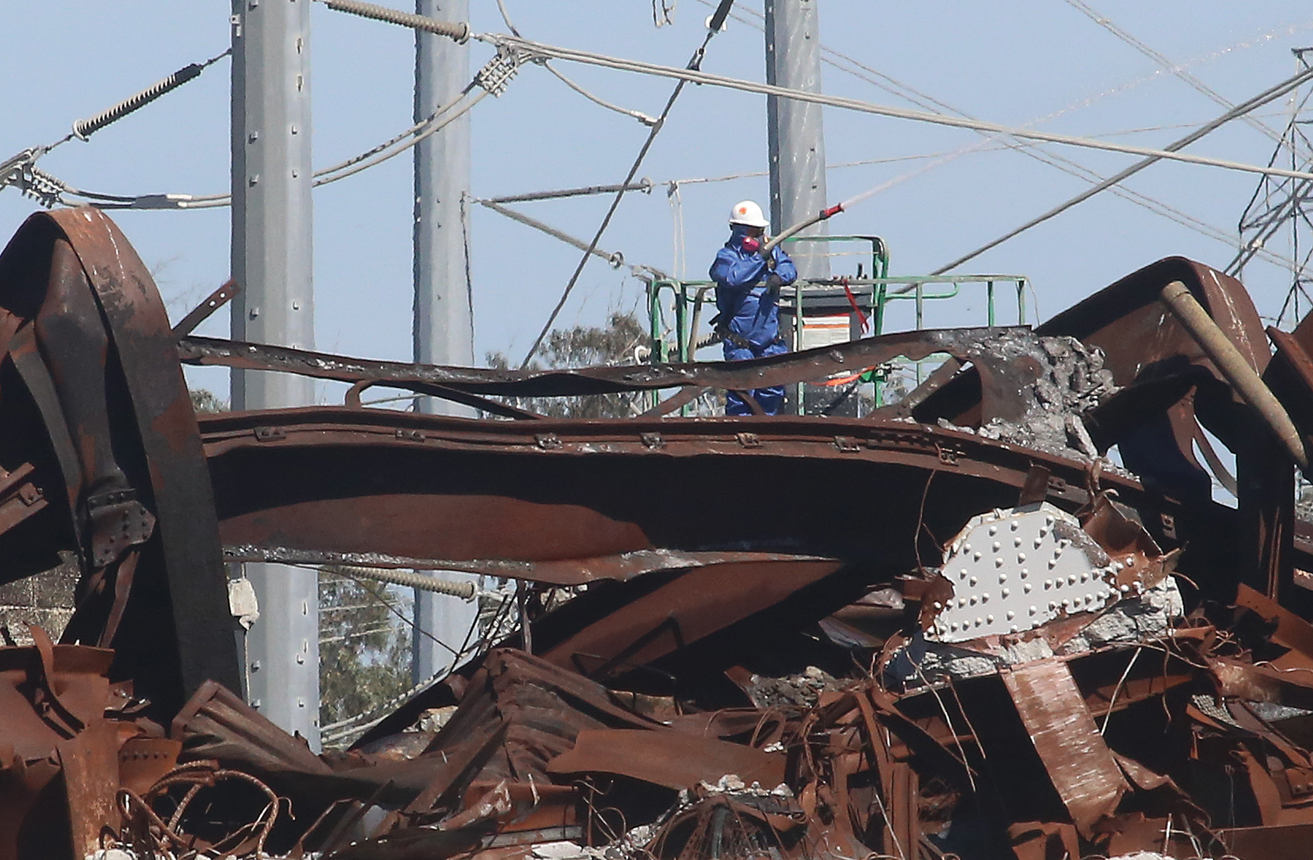
First, the county provided an update on the Moss 300 Recovery site. It is one of the three battery systems at the site, and is operated by the Vistra Energy Corporation, but owned by PG&E. It was the one that was mostly destroyed in the Jan. 17, 2025 fire.
It is in phase one of the cleanup and recovery effort, with 23,800 out of 35,772 lithium-ion battery units—about two-thirds—having been de-energized, removed and sent to an out-of-state recycling facility.
Phase two of the recovery is expected to begin in the middle of 2026, with “more extraction and removal,” officials said.
There had been some discussion of restarting Moss 100, a second site where 256 Tesla power units had provided power before Jan. 17 fire.
Those units had caught fire on Sept. 20, 2022. According to Dave Gabard from PG&E; the vent shield in a megapack was incorrectly installed, causing thermal runaway from a water leak. It turned out that 88 other megapacks needed to be repaired. Tesla has since modified the units and the alarms. The board declined to restart Moss 100 at this time.
Thermal runaway at a battery plant is a fast-moving chain reaction inside lithium-ion cells that can’t be contained once it starts. Internal temperatures can spike past 572 degrees Fahrenheit in milliseconds. The reaction begins when heat builds faster than it can be released, triggering gas buildup, toxic smoke, fire and, in some cases, explosions.
Hydrogen chloride and carbon monoxide were released in the smoke of the Vistra fire, scientists said. Catch basins collected the water so it did not go into the sloughs or bay. The system was shut down, Hwy. 1 was closed for 12 hours and a “shelter in place order” was issued by county officials.
Weiying Jiang and Michael Garland, staff toxicologists from the Department of Toxic Substances Control, presented preliminary findings that found that to date there were no strong human health or ecological risks from chronic exposure. Although toxic metals associated with battery construction were found, they determined that the amounts they found were either naturally occurring or not in amounts to put humans or the environment in future danger.
They noted a February 2025 report from California Department of Fish and Wildlife (CDFW) of a decline in the mosquito population after the fire in the area surrounding the Moss 300. They also referenced in that report the finding of 6-inch pieces of what appeared to be fire debris in Hester Marsh. Soon after, those pieces disappeared with the rains. Because DTSC did not start their investigation until eight months after the fire, that debris was not available to investigate. They emphasized that the results are still under review.
Estuary Monitoring of Battery Emissions and Residues (EMBER)—a group of scientists associated with Moss Landing Marine Laboratories—gave the next presentation. They represent Elkhorn Slough Foundation, Elkhorn Slough National Estuarine Research Reserve, Moss Landing Marine Laboratories, the Monterey Bay Aquarium and Amah Mutsun Land Trust.
Kerstin Wasson,who spoke for the group, said that EMBER already had data on many parts of the slough going back years, and jumped into action soon after the Jan. 17 fire.
That data includes metals measured in Hester Slough in 2023, which served as a baseline for after the fire.
The large 6-inch pieces of fire debris referenced by the DTSC toxicologists were collected and analyzed, and found to be “pure cathide battery metals.”
Since many of the pieces dissolved in the rain, it is likely that those metals are in the slough, researchers said.
The pieces were preserved, and are currently available for examination.
The ash layer on the soil was very thin at 1 to 5 millimeters. When analyzed shortly after the fire, the concentration of nickel was ten times the 2023 measurement. The DTSC sample, which was done 8 months later, measured 3 inches deep in the soil, so the concentration would have been diluted.
Through their analyses, they concluded that highly concentrated metals of nickel, cobalt and manganese found in thin patchy layers in Elkhorn marshes matched the proportions of metals and particle morphology of batteries.
The rapid redistribution of the metals from the fallout from rains and tides flowed into the estuarine ecosystem. They did not disappear.
The team also found cobalt and nickel in collected species of mollusks, crustaceans, fish, plants and algae.
There is a 10-year study of mussels, but when they were tested after the fire, no evidence of battery metals were found.
EMBER noted that bioaccumulation can be a slow process, so researchers said there needs to be more research.
EMBER’s main theme was that it is essential to conduct soil samples and take samples of organisms right after the fire to best determine the ecological impacts .
That needs to be followed by long-term sampling to determine if the metals have affected the environment through bioaccumulation.
Never Again Moss Landing (NAML) gave a thorough report on their findings and their continued activities. That group received results from the hair samples collected earlier in the year from community members.
NAML’s website contains information with ways to receive emails and to donate.
Greg Bishop from Central Coast Regional Water Quality Control Board reported on concerns about the dangers in the runoff after the fire.
His group is looking to work with Vistra on what’s in the sediment and where it goes. The Moss Landing Harbor gets dredged periodically, and runoff also goes into the sloughs as demonstrated by EMBER’s study on Hester Marsh.
Supervisor Glenn Church, whose district includes the power plant and has been proactive in keeping this issue alive, worried about the danger of continued bio-accumulation over time.
Speakers from industries such as fishing, farming and tourism, as well as residents, also expressed concern during public comments. One speaker was concerned about Vistra paying for the DTSC’s reports that ended up finding no health or environment risks in their preliminary findings.
The board seemed receptive to the reports and comments, including that the reports should be shared and considered collectively.