
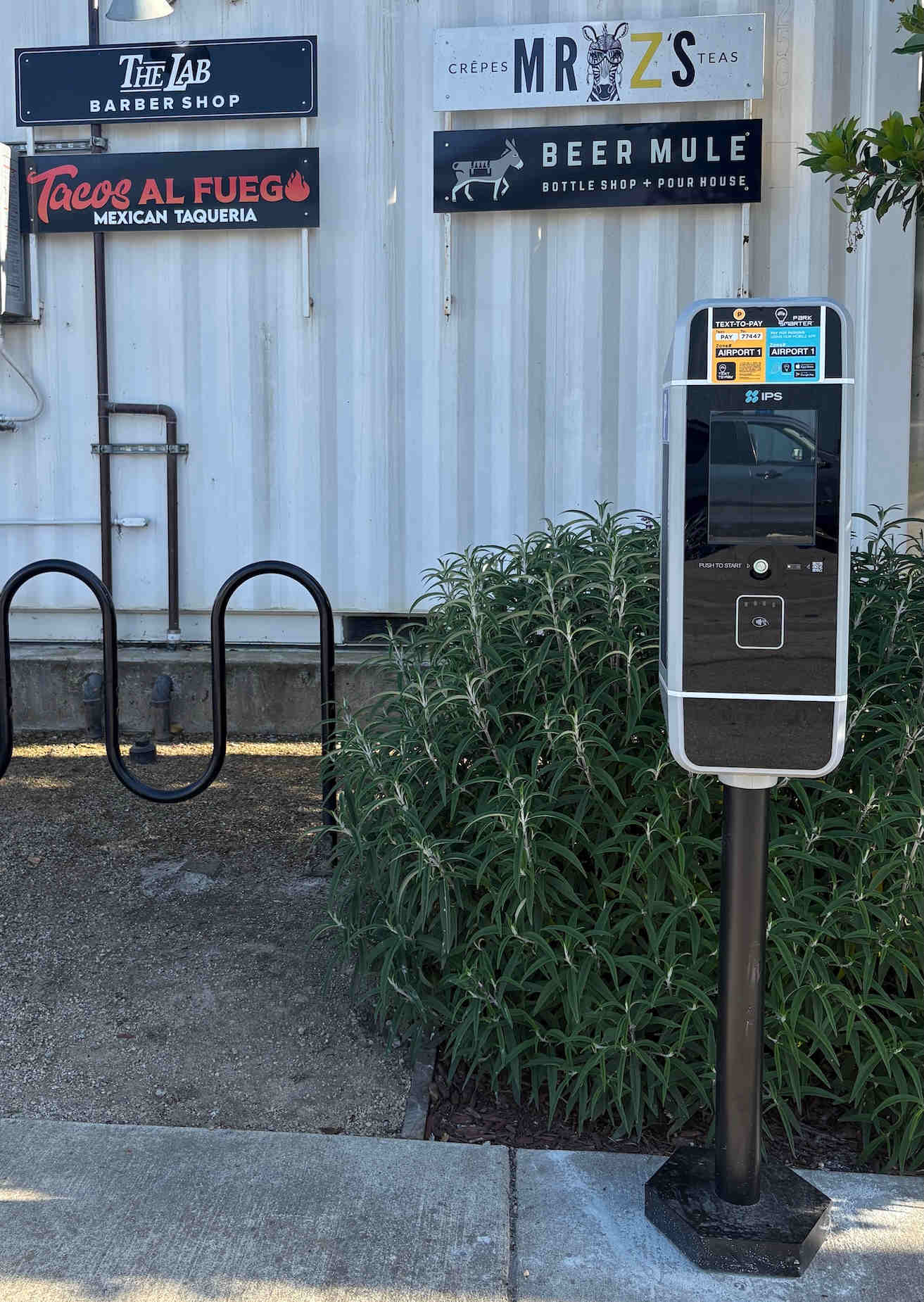
Watsonville is testing a pay-to-park program along parts of Aviation Way, a 30-day pilot that City Manager Tamara Vides said will be used to gauge the feasibility of future metered parking.
Customers who recently visited the strip of restaurants at 45 Aviation Way—including Honeylux Coffee, Beer Mule and Slice Project—have found informational flyers on their windshields explaining the temporary system.
It will be enforced Monday through Saturday from 8 a.m. to 8 p.m., with rates ranging from $1 to $2 depending on the time of day.
The program will run through May 27.
Vides said any final decisions about where—and whether—to implement a permanent parking program will come to the Watsonville City Council for approval.
“I can assure you, council, that we will engage with all businesses and the community at large on this topic,” she said.
But during Tuesday’s council meeting, business owners expressed frustration that the program in front of the popular destination could deter customers.
Brando Sencion, owner of Slice Project, said he was forced to pay $2.50 at a kiosk to park on the street while delivering supplies to his business that morning.
“We have seen a huge dip even just in the last two days in people showing up to our location at 45 Aviation Way,” he said. “I would really encourage you to review this parking situation happening in these very high-volume areas. I feel like the city is being very strategic and predatory in the sense that you’re taking advantage of the success of our businesses to make more money.”
Shawd DeWitt, co-owner of Beer Mule, estimated the meters will cost businesses thousands of dollars per year in lost revenue.
That includes paying employees a supplement to park their cars, as well as customers who may choose to get their morning coffee elsewhere to avoid parking fees.
Visitors who come for dinner in the evenings could face an additional $4 to $6 in parking fees, he said.
DeWitt acknowledged that part of the program’s goal is to encourage turnover of parked vehicles and bring in more customers. But he said that approach doesn’t work for the Aviation Way business corridor.
“All of the businesses there do not want higher turnover,” he said. “They want people to stay—get a haircut, get a coffee, get a beer, get some tacos. They don’t want them to leave. They want them to be comfortable in all of our open spaces and enjoy themselves.”
Councilman Jimmy Dutra agreed and said he was caught off guard by the program’s launch.
“That is one of our successful areas. We don’t want to really put a wrench in it,” he said.
Councilman Eduardo Montesino, whose district is not affected by the program, said he has nevertheless been receiving calls from frustrated residents with questions he could not answer.
“I need to know what’s happening, when it’s going to happen—not after the fact,” he said.
Montesino asked that the program be immediately moved to the downtown corridor.
“I don’t think it’s needed,” he said. “In my view, at the airport, it makes no sense.”
In other action, the council unanimously approved the city’s Vision Zero Corridor Study, a grant-funded planning effort aimed at reducing traffic deaths and injuries along major roadways.
The study, funded by a $390,293 Caltrans grant approved in 2023, focused on Freedom Boulevard and involved community outreach and technical analysis by consultants. It examined crash data, gathered public input and developed design concepts to improve safety for all road users, including pedestrians, cyclists and drivers.
Two main improvement alternatives are proposed, featuring measures such as continuous sidewalks, buffered bike lanes, narrower vehicle lanes, enhanced crossings and traffic-calming features. A third option — maintaining current lanes while acquiring additional right-of-way — was not fully explored due to feasibility constraints.
The study aligns with the city’s General Plan, Complete Streets guidelines and Vision Zero goals. It does not authorize construction and is exempt from environmental review because it is a policy-level document.
City staff recommended approval, noting that accepting the study is required under the grant agreement. Failure to do so would have jeopardized the funding.