

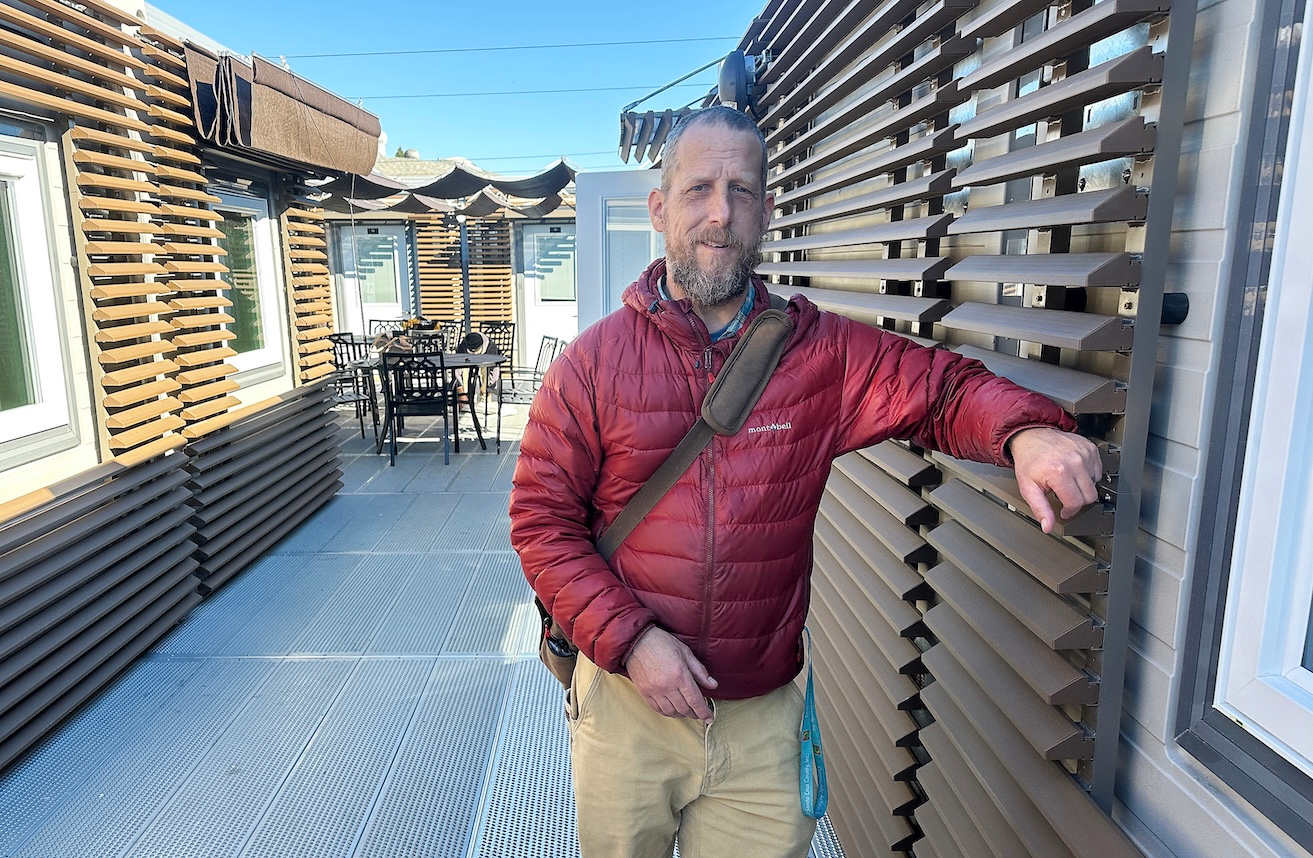
A new 34-bed navigation center aimed at helping unhoused residents living along the Pajaro River corridor officially opened Monday in Watsonville, marking a major milestone in a rare cross-county homelessness partnership.
Hope Village, located at 118 First St., began operations May 18 during Affordable Housing Month.
The 24-hour, low-barrier facility will provide temporary housing and supportive services for people displaced by the upcoming Pajaro River levee expansion project.
The project was developed through a collaboration involving Santa Cruz and Monterey counties, the Pajaro Regional Flood Management Agency, Westview Presbyterian Church and Community Action Board of Santa Cruz. Funding came primarily through California’s Encampment Resolution Fund and the Central California Alliance for Health.
County officials and local leaders said the project addresses both a humanitarian need and a long-standing regional problem along the river corridor.
“Floodwaters do not stop at county lines. Housing challenges do not stop at county lines. Poverty, public health and human suffering do not stop at county lines,” Monterey County Supervisor Glenn Church said during the opening ceremony.
“What affects Watsonville affects Pajaro,” Church said. “What affects Pajaro affects North Monterey County. And our futures are tied together, whether we acknowledge it or not.”
Santa Cruz County Housing and Health Division Director Robert Ratner said the project grew out of community discussions that began in 2024 and reflected a broad coalition working together to respond to homelessness.
“This moment really strikes me,” Ratner said. “The fact that we’re in this moment speaks to the village concept — so many different people coming together to face challenges.”
Ratner said the site is intended to offer stability for people who have struggled with housing insecurity amid rising costs of living and healthcare.
“Hope Village is a critical part of finding a way to help people who have experienced the hardships of life and challenges of making it economically through a really difficult financial situation, healthcare situation, with the cost of housing the way it is, and giving them a path to stability and security,” he said.
Officials said people have historically lived along the levee with few shelter alternatives on either side of the county line.
“There’s been a history in Watsonville and Monterey County of people living on the levee without shelter options on either side of the river,” Ratner said. “This is not safe. It’s not secure.”
The village was designed as a non-congregate shelter model, with modular sleeping units that include privacy, storage and accommodations for pets and couples.
The facility is being operated by Community Action Board of Santa Cruz on land owned by Westview Presbyterian Church.
Community Action Board CEO MariaElena De La Garza said questions about whether residents came from Santa Cruz or Monterey counties missed the broader reality of homelessness in the Pajaro Valley.
“My answer was this: ‘It doesn’t matter,’” De La Garza said. “Our wonderful residents that have trusted us enough to move into this community are from both counties and the city of Watsonville.”
“Sometimes they live on that side. Sometimes they live on this side,” she said. “Sometimes you find them over by the railroad tracks in Pajaro.”
Watsonville Mayor Kristal Salcido said the project required extensive outreach and collaboration to move forward.
“It really took a lot of conversation and engagement to get here,” Salcido said. “The lynchpin to get here was Community Action Board.”
Monterey County Supervisor Luis Alejo linked the project to the region’s recovery from the devastating 2023 Pajaro floods.
“Along the Pajaro River, we see both an urgent need to protect our families and businesses from devastating floods as we endured in 2023 together, and an equally urgent need to provide real sustainable solutions for our neighbors experiencing homelessness in the river channel,” Alejo said.
The project was funded through an $8 million Encampment Resolution Fund grant awarded to Monterey County by the state in 2023. Officials said the funding is expected to sustain operations through July 2027, after which Santa Cruz County is expected to assume responsibility for operating the village.
Monterey County Homeless Services Director Roxanne Wilson said the project required years of planning and coordination.
“It was not easy, but we did it — all of us together, very strategically, very intentionally, very thoughtfully,” Wilson said.
Wilson told The Pajaronian that future funding could include Medi-Cal reimbursable services through California’s CalAIM initiative, supported by startup funding from the Central California Alliance for Health.
“And after that, we’re just like the rest of the homeless sector,” Wilson said. “We’re just gonna scrape by and figure it out.”