

Sarah Weaver sat in the alcove of her tent alongside Corralitos Creek on Monday as her tiny dog, Booty, darted about on a long leash.
Behind her, in a living space concealed by layers of tarps and blankets, was the entirety of her life: a bed, overturned buckets serving as chairs and a handful of necessities.
It was a life that would soon change.
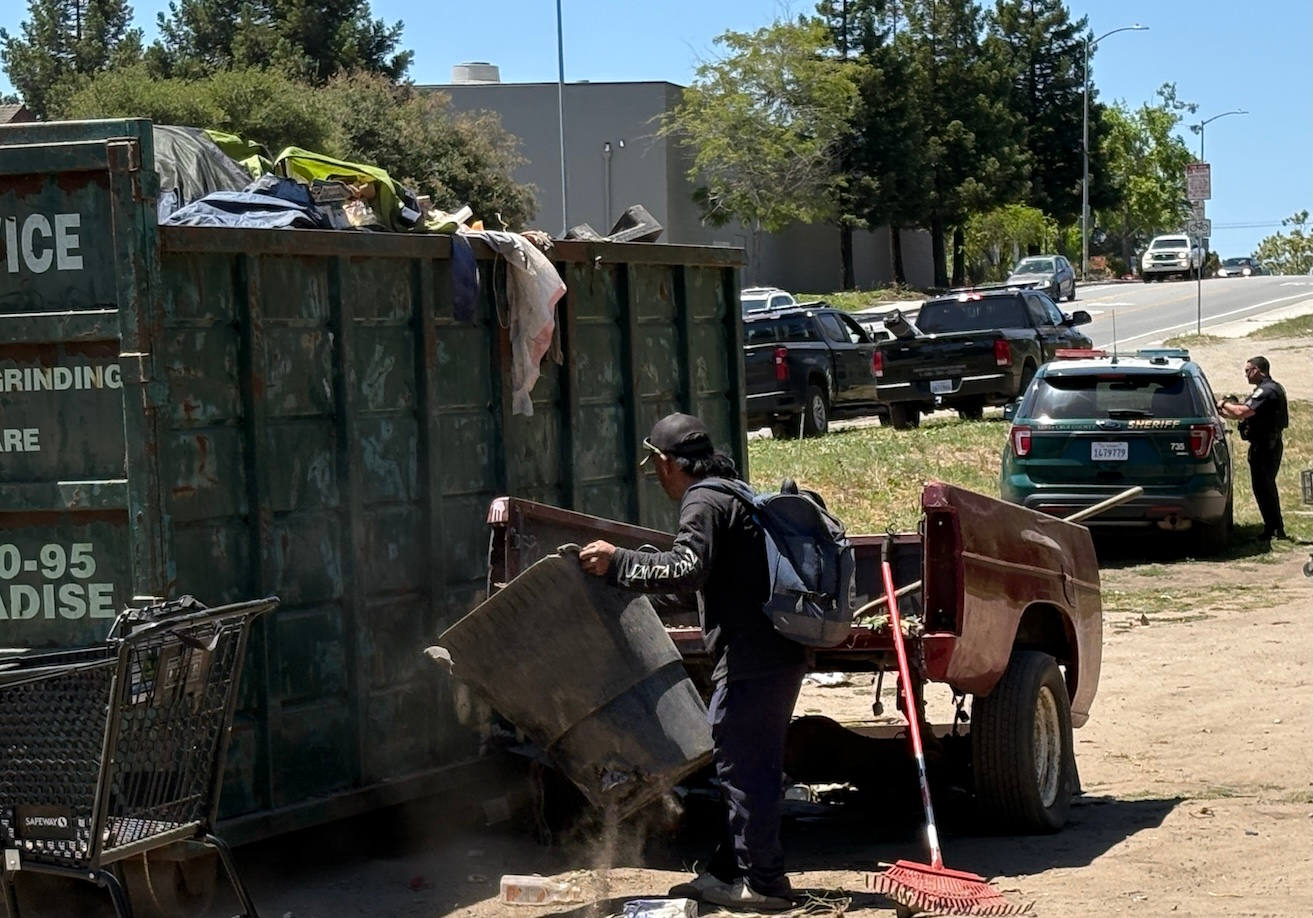
She is among dozens of people who called the property home until May 14, when the property owner handed out notices ordering residents to vacate. Work crews arrived Monday morning to begin clearing belongings, trash and makeshift structures from the site.
Weaver has been living in the unsanctioned encampment since 2023 after her mother suffered a stroke and was placed in a nursing home, and the mobile home where they lived was sold.
“I had 15 minutes to pack my life,” she said.
That desperate realization has since become her day-to-day reality, knowing that wherever she went, she and her neighbors could be forced to move again.
Weaver is an artist whose painting “The Boy Behind the Mask” hangs in director Spike Lee’s personal collection.
Maintaining that career has become difficult, especially after her van containing artwork and supplies was towed because it lacked registration.
She said city and county officials have offered assistance options, but few are realistic, particularly for people with pets.
“It’s like we’re getting smacked in the face at every turn,” she said. “But I believe we’re good people, and I know that a lot of us are really smart and really kind, and we’d give the shirt off our backs to somebody who came down here.”
The hillside encampment — a 2.75-acre wooded area along Corralitos Creek across from the Freedom Centre shopping plaza — has been the subject of previous enforcement actions and cleanups prompted by complaints from nearby residents and businesses. City officials say the property, which has no formal street address, has housed as many as 40 people.
This marks the first time the property owner, Fremont-based KDS Dhaliwal Investments, has taken responsibility for overseeing the cleanup.
Residents and city officials have long raised concerns about trash accumulation, makeshift shelters and vehicles leaking fluids onto the property. City staff have also linked activity at the encampment — including bathing, laundry and human waste disposal — to pollution in the creek.
KDS Vice President of Operations Karam Singh said the company delayed stricter trespassing enforcement during an ongoing dispute with the city over proposed development plans for the site, including potential retail and car wash projects.
Singh told The Pajaronian that the company has several ideas for the property and plans to bring in surveyors to assess the land.
Before that, however, he said the company plans to install fencing once residents have left the site.
“At this moment, we are putting 100% of our efforts into cleaning, and we’ll see what to do later on,” he said. “It’s very hectic. It’s a lot of work.”
Questions over how the camp could legally be cleared have become a point of tension between residents and property owners.
Weaver said residents should be afforded due process and argued that the length of their stay gave them tenant protections.
“We just want to be treated like people, not trash,” she said. “We don’t want to be erased. We know we can’t stay here.”
Under California law, squatters and trespassers are treated differently based on the duration and nature of their occupancy. A squatter is generally considered someone who occupies property without permission while intending to reside there. In some cases, people who remain on a property for an extended period may gain legal protections requiring a formal eviction process before removal.
Trespassers, by contrast, are typically considered temporary unauthorized occupants and can often be removed more quickly under California trespassing laws. Senate Bill 602, which took effect in 2024, extended the validity of trespass authorization letters filed with sheriff’s departments from 30 days to one year, making it easier for law enforcement to remove unauthorized occupants without a court-ordered eviction.
Alexis, 22, who declined to give her last name, said she had been living at the property for three years.
She had frantically packed her belongings but was unsure where she would go next.
Alexis said she would miss the community that formed there.
“When you’re hungry, we help each other out,” she said. “When you need clothes, they provide them for you.”
Courtney Davis, 33, said she had been living at the camp with her mother and sister for the past three years.
Davis, who said people frequently drive by shouting insults at residents, said she wants the community to understand that the people living there deserve respect. Many residents, she added, struggle to find work without a permanent address and face barriers to securing stable housing.
“They just think we’re horrible people down here, but we’re not,” she said. “We’re people just like everyone else.”