
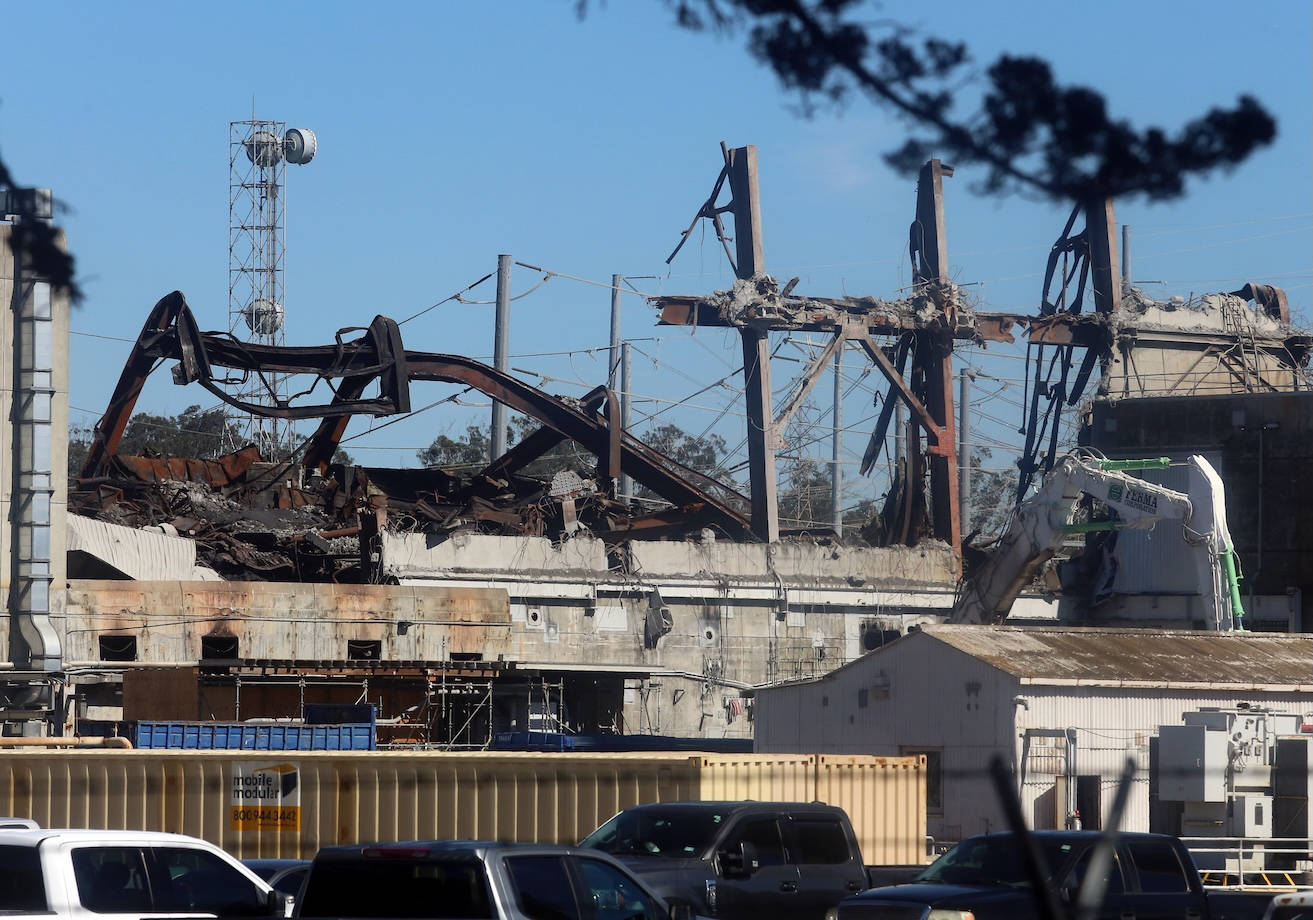
A fire on Sept. 18 burned through part of the battery energy storage facility that was significantly damaged during the January 2025 Vistra battery fire.
Monterey County officials announced the fire was no longer an active threat around noon later that day, though shelter-in-place notices were in place until later Friday afternoon.
Workers at the Vistra plant noticed a flare-up early Friday morning when roughly 1,200 inaccessible battery modules that were still charged spontaneously ignited, said Chief Jess Cortez with the North County Fire Protection District in a briefing Friday afternoon.
During the 2025 fire—the cause of which is still unknown—toxic black smoke choked the air for days, affecting air quality as lithium-ion batteries containing nickel, manganese and cobalt burned.
The incident sparked widespread public concern and increased scrutiny of plans for battery energy storage system (BESS) facilities, including a proposed project by Invenergy on Minto Road near Watsonville.
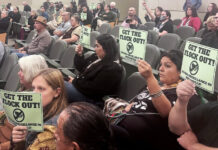
Though the fire on Friday was nowhere near the level seen in 2025, residents are raising concerns about the potential health impacts and organizing against the proposed Seahawk Battery Energy Storage System on Minto Road.
“This is a hazardous industrial use that is being allowed by the county of Santa Cruz to be constructed and operated on land zoned for agriculture and that is adjacent to a densely-populated working-class families, and near schools, elderly and youth care centers and the College Lake ecosystem and water supply,” said Becky Steinbruner, a community advocate and resident of rural Santa Cruz County.
Steinbruner has been active in the fight against Seahawk and encourages residents who experienced physical symptoms last Friday and Saturday to report their symptoms to their County Health officials for documentation.
Nina Audino, founder of Stop Lithium BESS in Santa Cruz County, supports BESS as a transition out of fossil fuel dependence—just not with lithium sited near communities.
Placing an industrial grid-scale lithium BESS on 16 acres of active, prime farmland violates the voter-approved Measure J policy and related county codes that protect farmlands, Audino said.
“We need to respect a lithium battery like we respect an open flame,” Audino said. “The grid scale LFP BESS proposed for 90 Minto Road presents untenable hazards to public safety, active farmlands and the surrounding natural habitat.”
Phoenix Artemisia, a local business owner and concerned resident, joined her neighbors in the ongoing effort to prevent Seahawk BESS from being built.
According to Artemisia, Watsonville isn’t the only location where a BESS could be built in Santa Cruz County.
“Nobody wants it in their backyard in the wealthier sections of Santa Cruz County,” Artemisia said. “The county supervisors are, I think, afraid of answering to their constituents. They just peg Watsonville as the most convenient place to dump this project.”
Audino, Artemisia and Steinbruner have been working with other concerned residents to protest this positioning, which lies within one mile of 2,000 residents who are predominantly Latino and working class.
1,480 residents have signed their petition urging the City to stop the Seahawk project.
“They just don’t think that people will be able to hold a good case about it, that they don’t have the education level or the money to fight back, but we’re going to show them something different,” Artemisia said.
Patrick Orozco, chairman of the Pajaro Valley Ohlone Indian Council and state-level cultural monitor, said he reached out to the Seahawk project managers regarding its placement near Ohlone burial grounds. The project developer said the project would not touch the cemetery.
“My main concern is the people that live in that vicinity,” Orozco said. “The project is going to affect their health and safety … and in the middle of College Lake, there’s a ditch that runs through there that’s spawning grounds for the steelhead (trout) and a sanctuary for the bird life.”
Audino, Steinbruner and Artemisia also pointed out evacuation issues with the planned BESS site, referencing construction on PG&E power poles at Minto and Green Valley Road that took half an hour to get through.
“If that’s what it’s going to look like whenever they’re building out a BESS, then imagine what would happen if there was a toxic lithium fire with people trying to evacuate,” Artemisia said. “There’s nothing for us there. Nobody would be able to move. Nobody would be able to evacuate.”
Audino said the decision to place the Seahawk project 500 to 700 feet from dense residential neighborhoods at the end of a no-through road ignores the critical safety risks inherent to BESS, “turning a hardworking, low-income and predominantly Hispanic neighborhood into a sacrifice zone.”
Artemisia said those looking to get involved can write to the California Energy Commission and submit an e-comment on the Seahawk project portal. A community meeting will be held on Saturday, Oct. 10 at noon at Pinto Lake City Park with speakers from Stop Lithium BESS, Ban Lithium BESS Santa Cruz and environmental and social justice experts. The meeting is a potluck, and Spanish translation will be provided.
Syd Fluker is a California Local News Fellow. Visit fellowships.journalism.berkeley.edu/cafellows.