

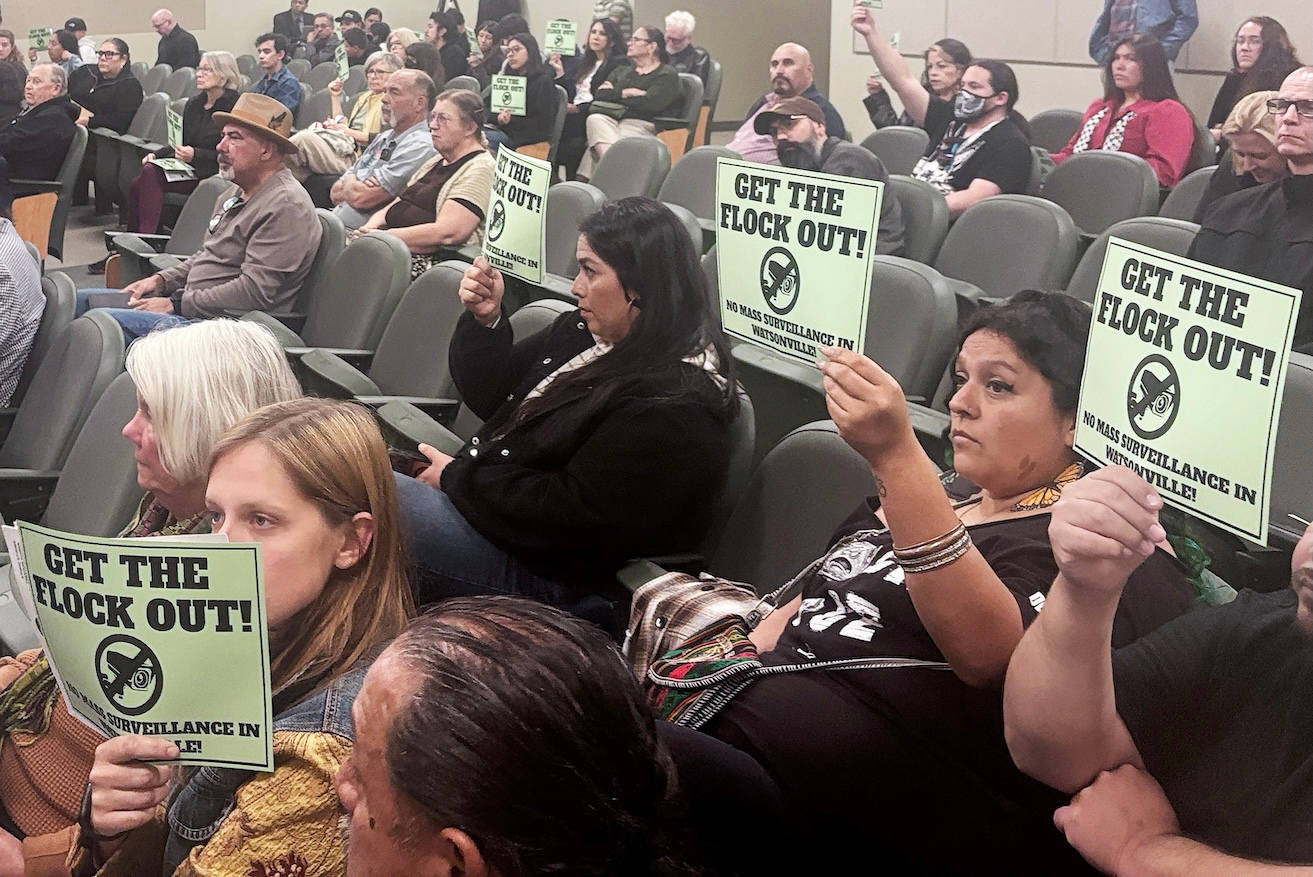
After months of public debate, the Watsonville City Council has decided to deactivate and remove 17 Flock cameras, reducing the number of cameras in Watsonville from 37 to 20. Additionally, data will only be stored for seven days as opposed to the previous 30 day period and will no longer be searchable by other police departments in California.
The Watsonville City Council voted 4-3 Tuesday evening to tighten limitations on the current use of Flock cameras by the Police Department. The city must also conduct a third-party audit, research public safety alternatives and organize a town hall concerning Flock camera usage.
Flock is one of the largest vendors of Automated License Plate Readers in the country. These cameras capture a wide range of vehicle characteristics: license plate numbers, make, model, color, and unique vehicle features like scratches, bumper stickers or missing plates.
While law enforcement agencies say the technology helps solve cases and find suspects in criminal cases, opponents see it in a different light.
They worry that it could be used by immigration officials, and say that the data has already led to the arrests of innocent people.
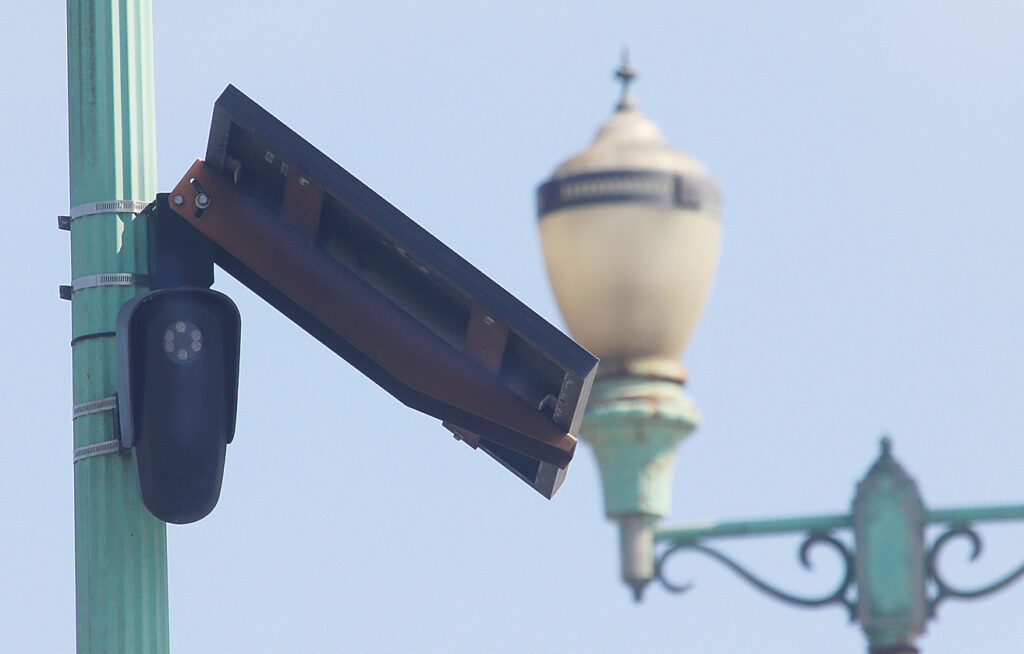
The American Civil Liberties Union in a report titled “You Are Being Tracked” says that the relatively new technology has no regulatory framework, and has been used by some law enforcement agencies to build permanent databases of information about millions of people.
During the meeting, Watsonville Police Chief Brian Shab and Assistant Police Chief David Rodriguez described Flock cameras as a vital tool for law enforcement, presenting on how the department uses the technology and the guardrails that are supposed to ensure responsible camera use.
“You can debate the appropriate safeguards, and we should,” Shab said. “We can debate the retention periods, access auditing, security and cost… But ultimately, when the next case happens, I want our investigators to have every lawful and appropriate tool available.”
Shab drew some criticism from the city council for showing the image of a man whose death remains unsolved to drive home an emotional point about the value of Flock cameras.
“Stick to the facts,” said Councilmember Eduardo Montesino in response to the presentation.
Watsonville Police Department said that the use of Flock cameras assisted in 894 cases. But when Councilmember Ari Parker asked for an estimate on the number of cases primarily solved using Flock, Shab put the number at “probably half a dozen.”
The issue saw a lengthy public comment, during which the vast majority of speakers urged the city council to cancel the contract. Elias Gonzalez, a Watsonville community member who ran for District 4 Supervisor earlier this year was among those who spoke in opposition.
“Surveillance is not the same thing as safety,” he said. “True public safety requires an investment in community. That means investing in young people, mental health and behavioral health services.”
Even after the reduction to 20 cameras, the Watsonville Police operate more Flock devices than any other city in the county. Critics at the meeting were wary of this disparity, noting that Watsonville has a much higher proportion of Latino residents than the rest of the county.
A smaller number of people spoke in support of the cameras. Former Mayor Lowell Hurst spoke as a community member defending camera use.
“Don’t allow the misuse of this technology, but make sure that your trusted officers have the tools that they need to keep us all safe,” he said.
Following public comment, the City Council launched into an extensive discussion over appropriate regulations. Councilmember Montesino suggested at one point to reduce data sharing to only neighboring counties, which failed to gain support. All members of the city council supported some level of new restrictions.
Councilmembers Dutra, Quiroz-Carter, Parker and Orozco supported the final terms, while Councilmembers Montesino, Clark and Salcido opposed them.
Quiroz-Carter was the only councilmember to express a desire to completely end the contract.
“I don’t think it’s safe. I don’t like it,” she said of Flock cameras. “But if the best that we can do is make some changes, I’m willing to do that with my colleagues.”
On the same day, Monterey County voted to shut down its Flock camera network completely. The Monterey County Board of Supervisors voted 3-2 to order the Sheriff’s office to close off access to all 63 cameras and remove them as soon as possible.
Wendy Root Askew, Kate Daniels and Glenn Church voted in favor of ending camera usage, while Chris Lopez and Luis Alejo voted to keep them.