

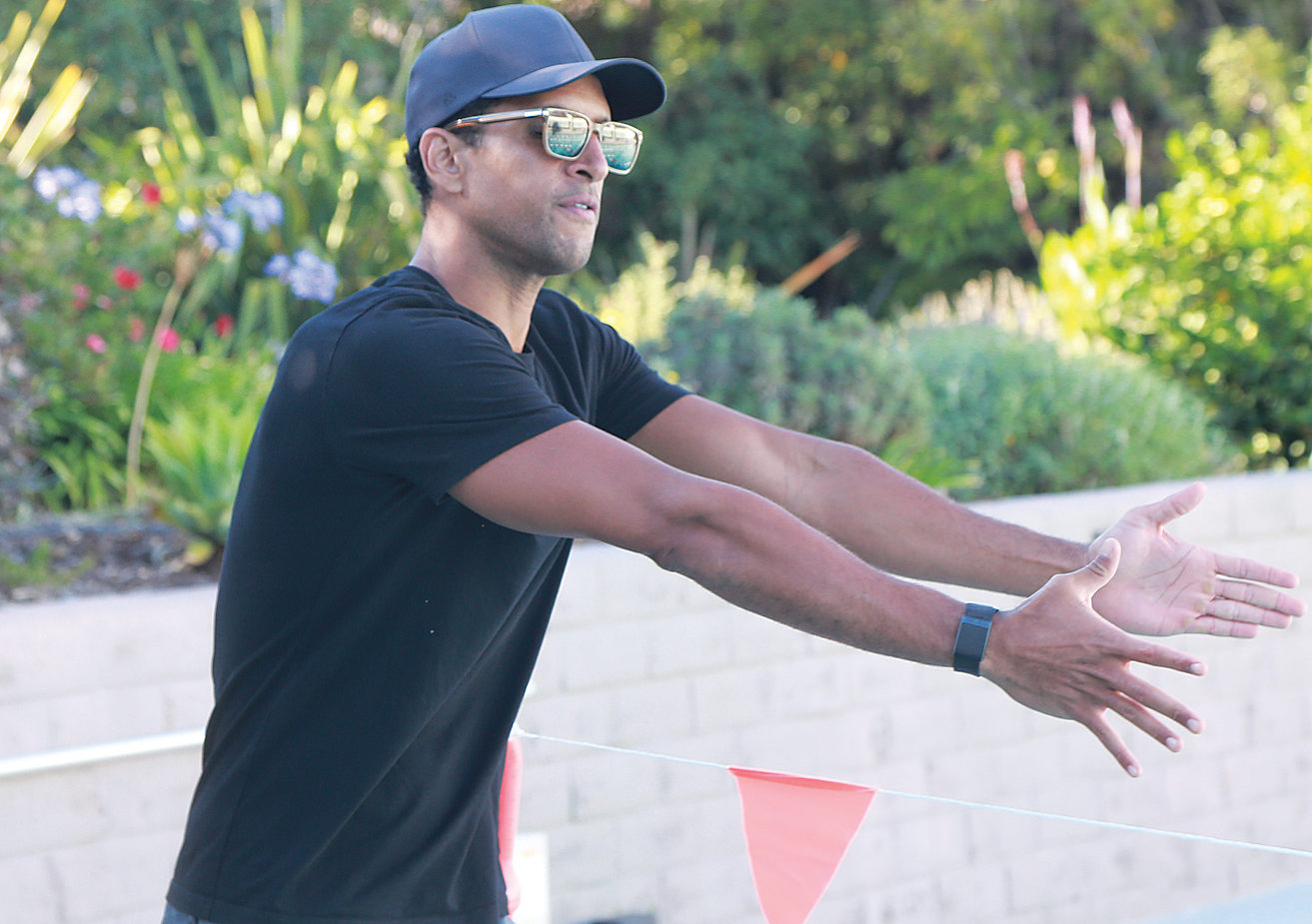
At Jim Booth Swim School, kids as young as 4 months spend time in the water, building the skills to become strong swimmers under the guidance of certified instructors.
Three-time Olympian swimmer Nicolas Nilo Oliveira didn’t get that opportunity.
Oliveira grew up in Belo Horizonte, Brazil, a landlocked city filled with buildings on top of buildings. He found swimming almost by accident when, at 10 years old with zero swim experience, he decided to jump into the deep end—literally.
Thankfully, the lifeguard saw him struggling and stepped in.
Oliveira began lessons with the lifeguard and developed a passion for the sport as he noticed his hard work paying off. When his talent became impossible to ignore, Oliveira sought out a competitive team.
“I always thought I was going to be a soccer player, just like any other Brazilian kid, but I ended up growing too big and goofy,” Oliveira says.
The closest team’s pool was at a country club that took a walk and a couple of bus lines to get there—an hour and a half each way. For the next six years, he took that journey alone almost daily.
Unsure of what to do following high school, Oliveira took inspiration from his teammates who had come to train in the United States, a world powerhouse when it comes to swimming. Oliveira didn’t have the finances, but when his best friend invited him to come stay and train with him in Miami, he took a leap of faith.
“It sounds like an easy step, but for me, at that time in Brazil, growing up how I grew up, having to convince my parents and come up with the money and visa and everything else to travel was a long process that everybody got involved in, from family to neighbors and friends,” Oliveira says.
So when an injury sent his friend home to Brazil indefinitely a couple of weeks before Oliveira’s flight, he took the coach’s number and kept the news to himself.
He landed in Florida, and the next few months flew by, filled with intense training and learning English by watching reruns of The Fresh Prince of Bel-Air.
Staring down the barrel of NCAA eligibility—a five-year window that limits student-athletes’ ability to compete in collegiate competitions—Oliveira had a few months to learn English and pass the SAT. But with the encouragement of his coach, “another angel in [his] life,” he did it, scoring high enough in math that the University of Arizona offered him a full scholarship.
Back in Brazil, his home life was changing drastically.
Wanting to give him the greatest chance at success, his dad waited until the exam was over before giving him the news: his mom had a stroke and was in a coma.
Oliveira went straight to the airport and managed to make it to the hospital with an hour left of visiting hours. A couple of hours later, his mother died.
“I have no doubt that she was basically waiting to say her goodbyes and to be there with me,” Oliveira says. “That has been the biggest transformational thing in my whole life. There’s nothing more painful than losing your loved ones, especially your parents.”
Oliveira spent 12 days in Brazil before boarding another plane, this time to Arizona.
Under the Tucson sun, Oliveira’s career progressed quickly. In 2005, he began competing for Brazil’s national team.
In the 2007 Pan American Games, he anchored the Brazilian relay team that took gold against the U.S.—with his dad and brother in the front row. The next year marked his first Olympic Games in Beijing, and in 2009, he set three South American records, two of which he still holds. By the time he graduated in 2010, Oliveira had acquired enough sponsors to continue swimming professionally.
After the 2012 Summer Olympics in London, he returned to Brazil full time for the first time in eight years.
“Brazil was selected for 2016 and I wanted to be there for the next four years because it was going to be an exciting time, just really living that opportunity to be competing and training for your own country,” Oliveira says.
While in Brazil, Oliveira opened a chain of health and fitness centers. He grew the business to eight locations and held ownership for close to 10 years before selling his shares.
By the time he retired in 2016, Oliveira had spent 11 years swimming for Brazil’s national team. For eight of those years, he was in the top 10 in the world for freestyle.
At 29, the time had come for him to move on.
Oliveira held various roles over the next few years, including a period as aquatics director at Stanford, starting his own acai business and working as an executive consultant.
After five years in consulting, Oliveira was burned out. Though working from home, he barely had time to spend with his newborn son, Dominic Nilo, who was one room over.
That’s when Oliveira met Jim Booth.
“I walked in and just fell in love,” Oliveira says. “This just felt so much closer to what I’m used to in regards to the people that I’m serving.”
Booth was looking to pass the torch at Jim Booth Swim School, where he has been teaching swim lessons for 50 years. Booth prides himself on the environment of his classes: children learn by having fun, and the school has a strict no-force policy.
“I needed somebody to step in and be with me and be excited about the program,” Booth says. “This legacy will continue with [Oliveira] and it’ll be with value added.”
Oliveira officially took over a few months ago, but Booth is still around helping Oliveira with things only someone with 50 years of local coaching experience would know.
While Oliveira isn’t in the pool coaching the students, he’s the one coaching the instructors.
“I’m a firm believer that you can still have fun and achieve a lot of things, so a lot of the foundation of what I do is built on having fun,” Oliveira says. “You don’t need to be ultracompetitive to still achieve quality.”