

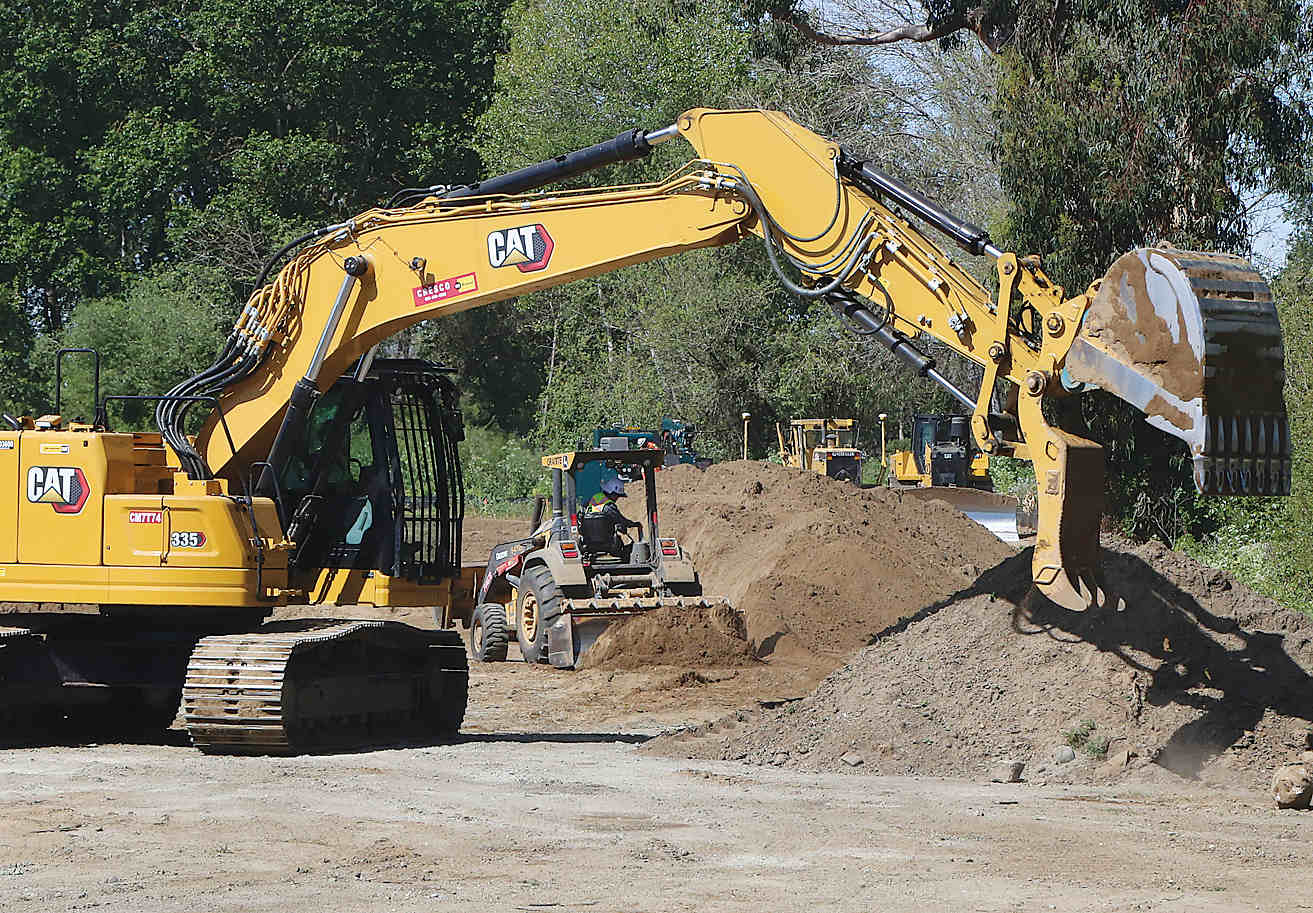
Construction is underway on a long-anticipated flood control project in the Pajaro Valley, even as state lawmakers push new legislation aimed at speeding up similar work along the Pajaro River.
Crews have begun work on what is known as Reach 6 of the Pajaro River Flood Risk Management Project, reshaping land near the intersection of Holohan Road and Highway 152 and building new setback levees along Corralitos Creek between Green Valley Road and East Lake Avenue.
The work is part of a broader $599 million effort to provide 100-year flood protection to Pajaro, Watsonville and surrounding agricultural areas, which have experienced repeated flooding for decades.
At the same time, Sen. John Laird has introduced Senate Bill 1055, which would give the Pajaro Regional Flood Management Agency additional contracting tools intended to accelerate flood control projects and reduce costs.
The bill comes three years after the March 2023 levee breach that forced about 3,500 residents to evacuate and caused an estimated $300 million in damage.
“Communities along the Pajaro River have experienced repeated flooding over many decades,” Laird said in a statement. “SB 1055 gives the Pajaro Regional Flood Management Agency additional tools to deliver levee and flood control improvements more efficiently.”
On the ground, progress on Reach 6 has already required significant changes to the surrounding area. An 18-unit apartment complex has been demolished and residents relocated. Nearby businesses, including a restaurant and hair salon, have also moved, while an adjacent real estate office closed after its owner retired.
Current work includes clearing vegetation and relocating utilities, with Pajaro Regional Flood Management Agency Executive Director Mark Strudley saying he expects Reach 6 to be completed this year.
Future phases will involve more complex infrastructure work, including raising bridges at Highway 152 and Highway 129, relocating a PG&E substation and transmission lines, and moving sewer lines under Reach 5 and Highway 1.
SB 1055 is designed to address some of the challenges that can slow those types of projects. The legislation would allow the flood agency to use alternative contracting methods such as design-build and construction manager/general contractor agreements, which supporters say can streamline construction and lower costs.
The Pajaro River levee system, originally built in 1949, has failed multiple times, with major floods recorded in 1955, 1958, 1995, 1998 and 2023.
Funding for the current project includes $149 million from the federal Infrastructure Investment and Jobs Act, along with an additional $55 million secured earlier this year by Sens. Adam Schiff and Alex Padilla.
Officials say the overall flood control project could be completed within five to eight years, aided by recent state legislation that streamlines environmental review.
Laird said SB 1055 builds on those efforts, emphasizing the need to continue investing in flood protection.
“We need to keep working at every level of government to reduce the risk of future flooding and protect our communities,” he said.