
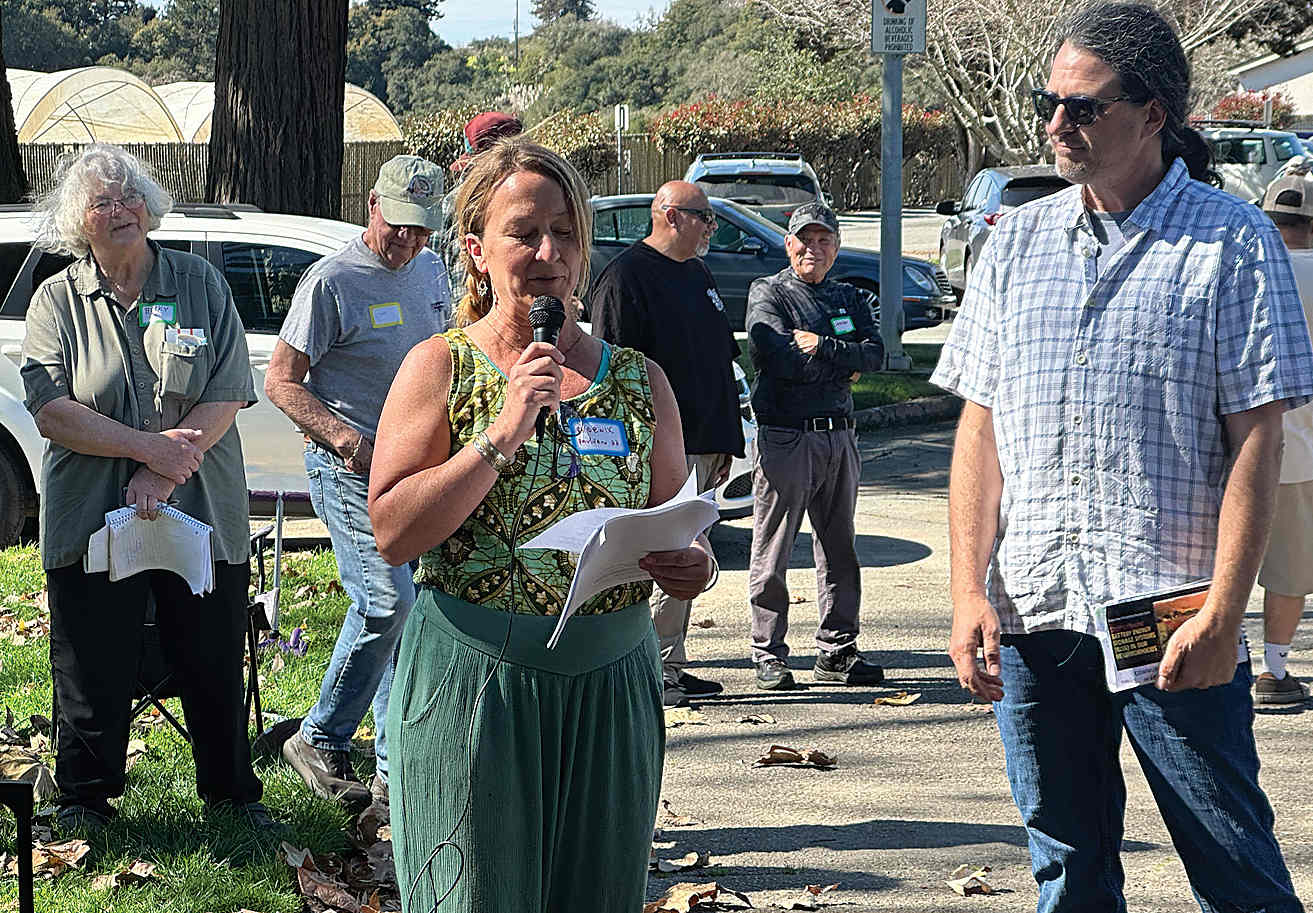
More than 150 people gathered Feb. 28 at Pinto Lake City Park to share ideas and information about a proposed Battery Energy Storage System (BESS) a few blocks away on Minto Road in Watsonville.
The public meeting, hosted by Stop Lithium BESS in Santa Cruz, featured several guest speakers and members of the public who addressed concerns about what organizers described as “the proposed hazardous, flammable, explosive BESS right next to homes at 90 Minto Road.”
Moderator Phoenix Artemisa told the crowd, “This facility does not belong in our county, and in an agricultural orchard at 90 Minto Road.”
Local activist Becky Steinbruner said, “Our supervisors have lost their way and they are not listening; how dare they approve this project. Don’t try Felipe Hernandez’s office because he is not listening. You have to write supervisors as well because if we are silent, they will take that as a consent. They have to hear from us.”
Steinbruner stressed that the public should not accept the “very minimum level of environmental review that they are planning” for the rules that would allow the 90 Minto Road Project, which is projected to be made up of “300 metal containers full of flammable, explosive lithium batteries.”
The project on Minto Road was proposed in January 2025 by Massacheussetts-based New Leaf Energy.
In a statement provided to The Pajaronian, New Leaf Project Lead Max Christian said that the project will meet or exceed the safety regulations included in Santa Cruz County’s draft BESS ordinance, which he described is “the strongest ordinance in the U.S., if not the world.”
Christian said that the project will include approximately 200 purpose-built, double-walled steel, sealed containerized batteries that will use stable lithium-iron phosphate (LFP) chemistry, as opposed to the more volatile, heavy-metal lithium-ion nickel-manganese-cobalt (NMC) chemistry that was used in first-generation systems like Moss Landing.
Each container, Christian said, will have its own remote monitoring and automatic shutoff system at the battery cell level, active cooling to prevent thermal runaway, and an on-board fire suppression system to prevent a fire in the event of thermal runaway.
Christian added that the project will meet or exceed state and national fire and safety codes.
“The emergency response plan for the project is being developed in collaboration with local fire agencies,” he said. “LFP battery energy storage projects in California have never experienced a metal container explosion.”
Much of the concern stems from the Jan. 16 fire at the Moss Landing Energy Plant that led to hazardous toxic fallout and a thermal runaway at the edge of the Monterey Bay Sanctuary and launched a massive rebellion in Monterey and Santa Cruz counties about battery storage systems.
Speaker Dustin Mulvaney, Professor of Environmental Studies at San José State University, explored the source of battery materials, where they are mined, how they are processed to how the batteries are used and where they are placed.
“And why am I interested in this: Because energy is a pretty dirty production all across the world,” he said. “In combination with climate change and air pollution, we anticipated this energy transition that we are going through, where we slowly replace our use of coal and petroleum with electrification, solar energy and wind power … and then the question becomes: How do we store that power? And that’s why batteries get proposed.”
He spoke of the use of “cleaner energy” and the life cycle impact of lithium, including extraction, mining, and processing of lithium chemicals and how that final product ends up being used and distributed fairly across society.
Mulvaney also spoke of LULUs, or Locally Unwanted Land Use, and how society deals with such land and how people’s ideas can vary sharply as to how that land can be used among other ideas.
Other topics covered included access to Minto Road, a curvy and hilly two lane road, especially in the case of an emergency; alternative routes are being discussed, one from nearby Diamond Estates and another off of Grimmer Lane where a massive school bus storage facility stands. Evacuation sites were also brought up, including the nearby Santa Cruz County Fairgrounds.
Local activist Omar Dieguez said he had lived on Elkhorn Road when the fire happened in Moss Landing and that he suffered itching eyes, asthma attacks for “four to five days.”
So what happens when they build this power plant here? It’s not if it (a fire) happens, but when it happens. This is an environmental problem.”