

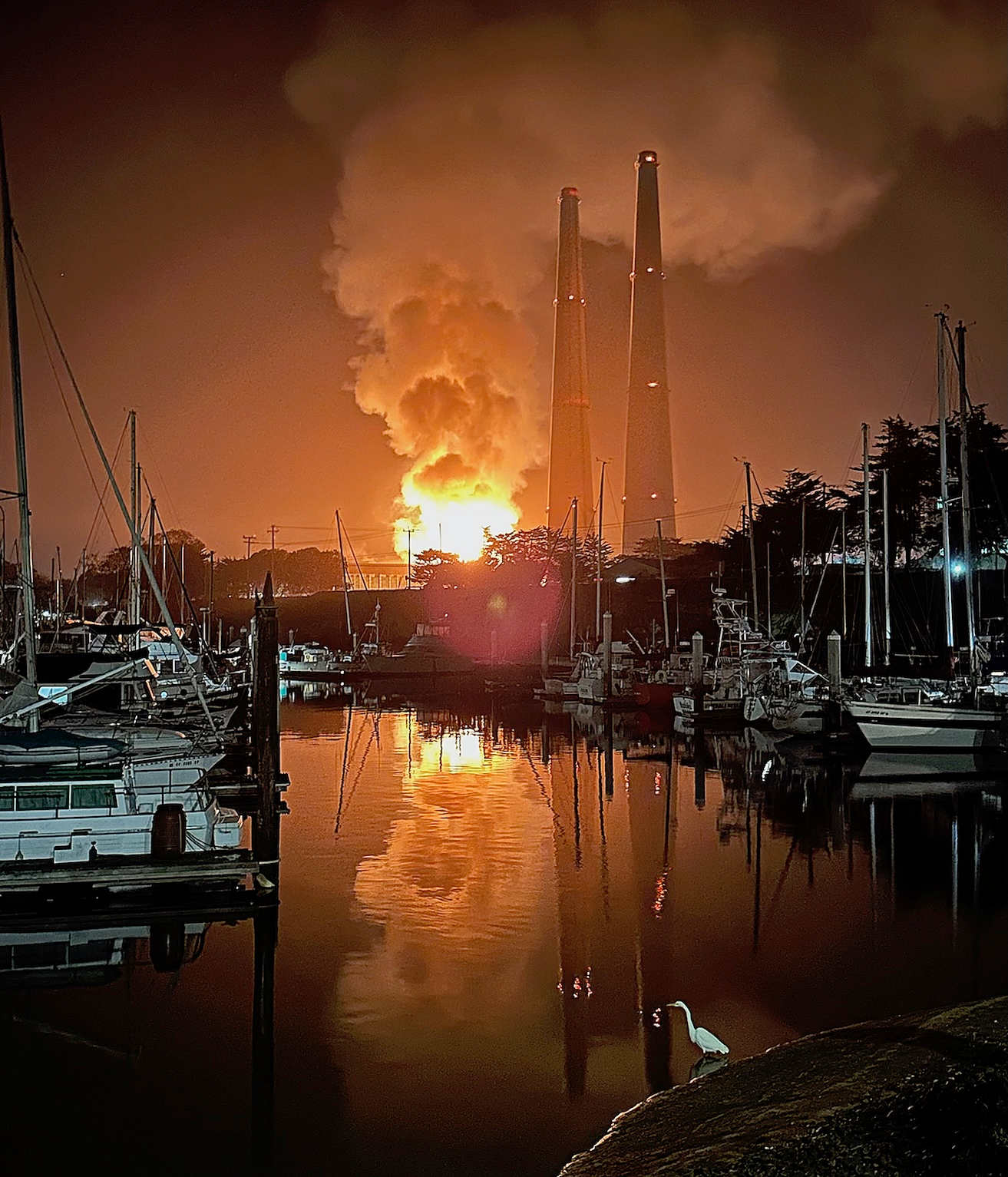
Editor’s note: This story came in part from a report by San Jose State University Professor of Marine Geology Ivano Aiello for the website The Conversation
The Jan. 16 fire at the Vistra battery energy storage plant in Moss Landing spewed an estimated 25 metric tons—55,000 pounds—of heavy metals into the air, which were deposited across roughly half a square mile of wetland around Elkhorn Slough.
That’s according to a report published Monday by San Jose State University Professor of Marine Geology Ivano Aiello on the website The Conversation.
Based on the amount of batteries that burned, roughly 1,000 to 1,400 metric tons of cathode material could have been carried into the smoke plume. What researchers found in local wetlands represents about 2% of what may have been released, Aiello said.
The fire burned for days, with thick black smoke spreading over farm fields and into neighborhoods. Residents reported a variety of maladies, such as headaches and respiratory problems.
The Environmental Protection Agency declared that the air quality met federal standards, but Aiello released an initial study in January that showed high levels of heavy metals in the soil.
“The smoke plume from the fire … released not just hazardous gases such as hydrogen fluoride but also soot and charred fragments of burned batteries that landed for miles around,” Aiello wrote. “The batteries’ metal fragments, often too tiny to see with the naked eye, didn’t disappear. They continue to be remobilized in the environment today.”
Aiello said that the metals can be a serious hazard for wildlife.
“These metals bioaccumulate, building up through the food chain,” he wrote. “The metals in marsh soils can be taken up by worms and small invertebrates, which are eaten by fish, crabs or shorebirds, and eventually by top predators such as sea otters or harbor seals.”
Aiello’s group is now tracking the bioaccumulation in Elkhorn Slough’s shellfish, crabs and fish.
“Because uptake varies among species and seasons, the effect of the metals on ecosystems will take months or years to emerge,” he wrote.







Somehow, 25 metric tons in the study turned into 55,000 tons in the headline. No wonder people mistrust the media.
Thank you for the catch, Glen.
Todd,
I am awed by your skill in reporting !
Your neighbor
Sorry to belabor the point, but across Dolan Rd. from the powerplant was the old site of Kaiser Refractories. That’s been gone for years, but was a declared superfund site at one time. A good follow-up question would have been, how much of the discovered heavy metal pollution was traceable to the battery fire, versus how much is historic residual from the smelting operations that used to go on there? These two different sources of pollution would have distinct signatures.
From Grok: “…The SJSU study’s 55,000 lbs of Ni/Mn/Co from the fire (localized to ~1 mile) is a blip compared to Kaiser’s chronic legacy. That plant dumped millions of gallons of metal-laden brine annually for 50+ years, contributing to ongoing slough contamination (e.g., chromium hotspots still monitored today). Pre-battery soil baselines already showed 2–5x natural heavy metal levels from industrial history—meaning the fire’s “fingerprint” is harder to isolate without this context.”