
On day two of our two-week road trip, my wife Sarah and I said goodbye to Bakersfield and drove southeast on Hwy 58 toward the Mohave Desert.
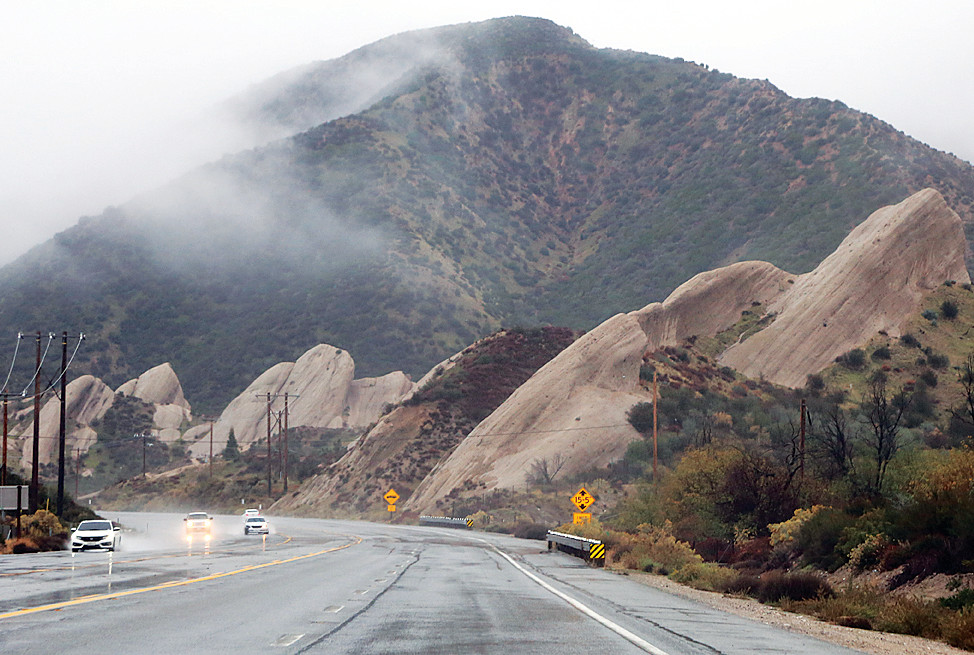
We were greeted with fierce rain as we climbed Tehachapi Pass on Highway 58. Our interest in taking smaller backroads backfired on this leg of the journey, because many of those roads are riddled with road washouts that are so well known that they have names. As the rain builds, the washes develop and surges of water rush across the roadways.
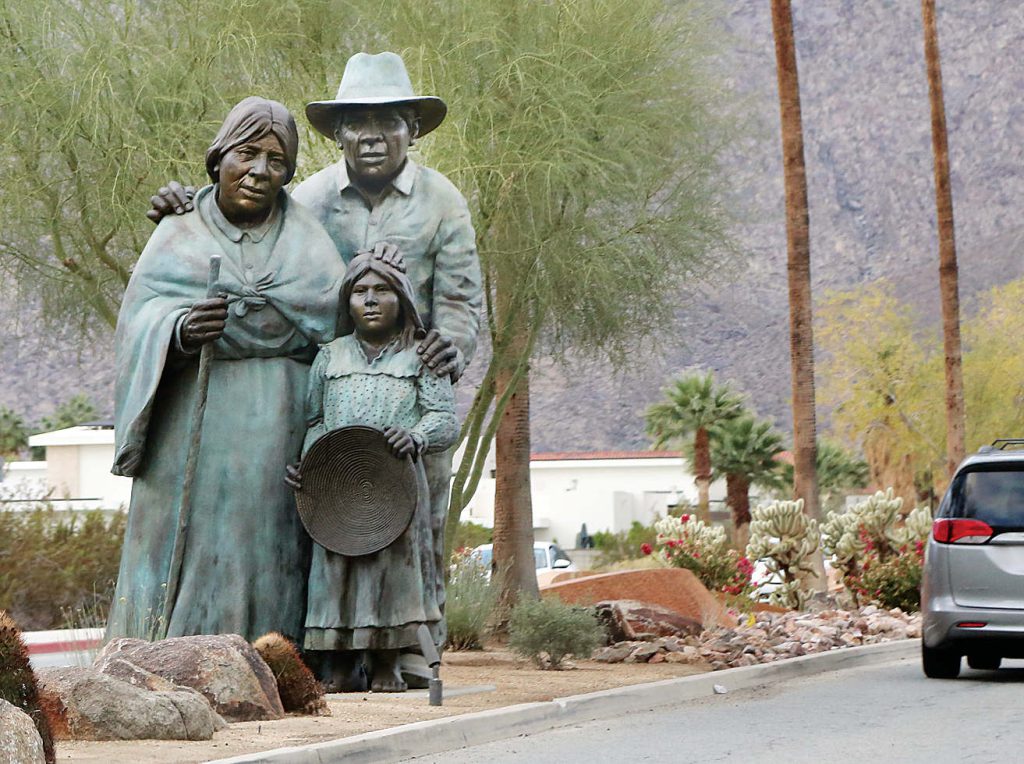
A large metal sculpture of the Cahuilla Band of Agua Caliente Indians on Tahquitz Canyon Way in Palm Springs. (Tarmo Hannula/The Pajaronian)
Our friend Cathy, who lives in Yucca Valley, warned us over the phone that “flash floods are real; take them seriously.” In one wash we drove through we went over a boulder that was hidden in the water and it made a loud clunk beneath our Hyundai. Fortunately we escaped serious damage, but about a mile later our luck hit another roadblock where the road was closed off with barricades due to flooding.
So we followed a few cars on a 90-degree turn north on an alternate route. That’s when we spotted a California Highway Patrol car parked awkwardly on the shoulder on a rugged mountain road. There beside the passenger’s side was a uniformed officer lying face down in the mud with his upper torso under the patrol car. In the driving rain we pulled over and I ran back to check on him. I hollered to him to ask if he was okay, and, to my relief, he groaned and pulled himself out from beneath the car.
“I hit a big rock and I had to check the under carriage of my car,” he told me.
“I think we hit the same rock!” I replied. After I helped him clear a bunch of mud and sand off his uniform, he paid deep thanks for us stopping. And he assured me we’d reach a safe highway in the direction we were traveling.
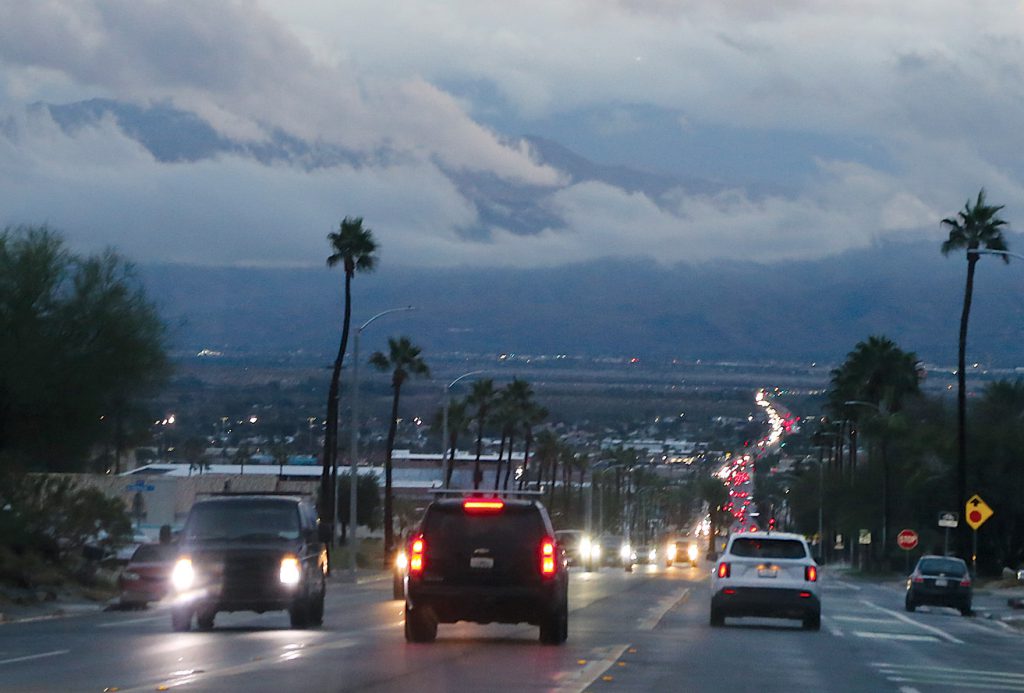
Dark storm clouds build up over Desert Hot Springs. (Tarmo Hannula/The Pajaronian)
We pulled into one of our favorite desert spots where we had reservations for the next two nights, Miracle Springs Resort and Spa in Desert Hot Springs. Just minutes from Joshua Tree National Park, the place overlooks Palm Springs and the Coachella Valley and features a courtyard of eight natural hot mineral pools.
A sculpture stands nearby with a placard that gives the history of Cabot Yerxa, who arrived in the Coachella Valley In October 1913, and began homesteading with 160 acres in Desert Hot Springs.
He dug a well near his home and discovered hot mineral water right outside his door.
He dug another well 600 yards away, and discovered the pure cold water of the Mission Springs Aquifer.
“The two wells, one hot, one cold, led Cabot to name his homestead Miracle Hill,” the placard reads.
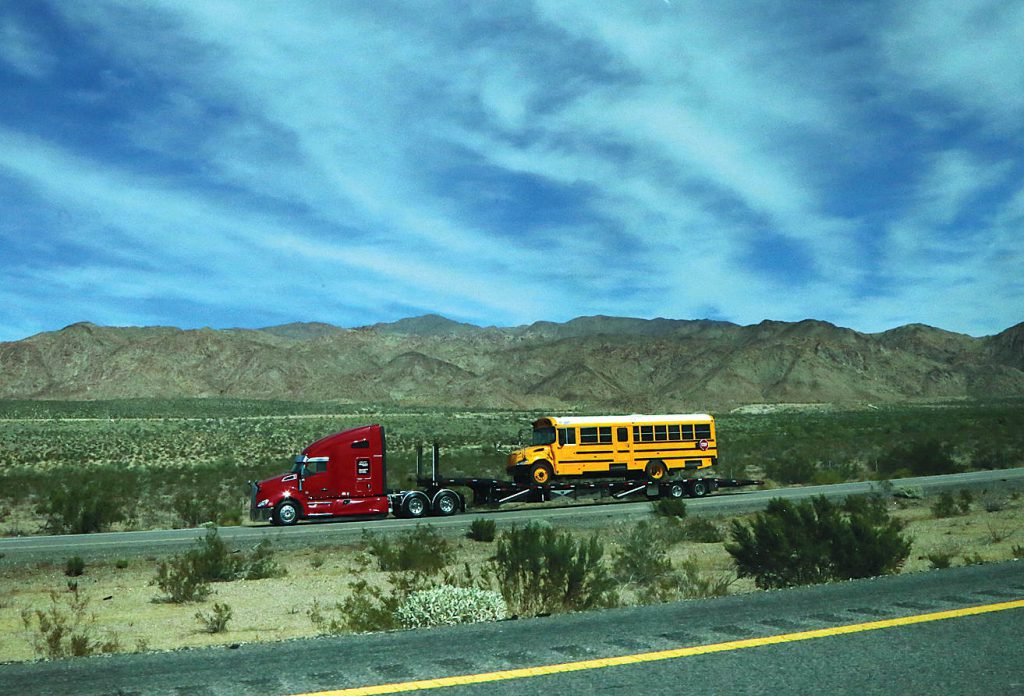
A tow rig hauls a broken down school bus on Highway 10 east of Palm Springs. (Tarmo Hannula/The Pajaronian)
In the next part of this trip we head east on Hwy 10 to Tucson, Arizona.