
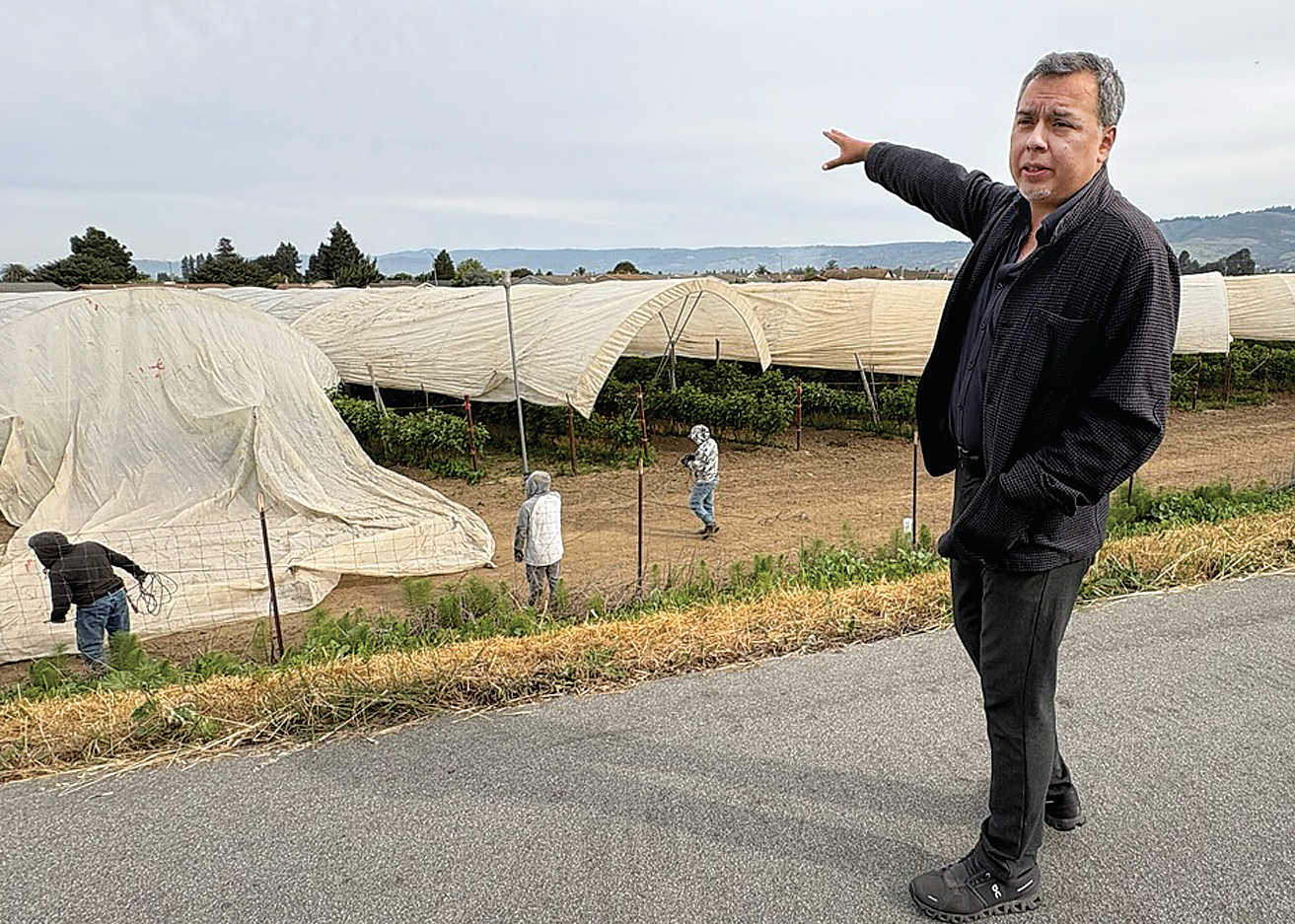
Adam Scow stood on the edge of a strawberry farm behind Pajaro Middle School Monday morning as he held a map showing similar fields adjacent to nine schools throughout the Pajaro Valley.
Scow heads up the nonprofit group Campaign for Organic and Regenerative Agriculture (CORA). The organization works to convince growers to create a 2,500-foot organic buffer zone around schools, where toxic pesticides are not used.
“It’s been well documented that conventional berries use some of the worst pesticides, and the most toxic pesticides in the growing process,” he told a group of elected and nonprofit leaders who took part in a “pesticide reality tour” of farms adjacent to schools.
The field behind the middle school—owned by Giant Berry company in Watsonville—stands bare now, but its long, manicured rows suggest it is ready to be planted for the upcoming strawberry season.
And in Santa Cruz County, that crop is king, with 2,640 acres growing 87,570 tons in 2024, for a total of more than $218.9 million.
But that yield comes with a price. To pump out that much fruit, many farmers resort to conventional growing methods, which typically means using tons of toxic chemicals.
According to the National Cancer Institute, Santa Cruz County ranks second in California for pediatric cancer rates among children ages 0 to 14. Between 2017 and 2021, the county saw 22.5 cases per 100,000 children, about 38% higher than the statewide rate of 16.3.
Scow called recent efforts to require better labeling and notification by farmers when they plan to use harmful chemicals “good steps.”
But CORA is demanding more, Scow said.
“Ultimately, what solves this problem is to not use toxic pesticides,” he said. “That’s what we’re calling for.”
Among the dangerous chemicals CORA is battling is 1,3-Dichloropropene (1,3-D), commonly known by the trade name Telone. That pesticide is injected into the soil and held in place by plastic sheets commonly seen on the rows of strawberry farms.
But it often escapes and drifts into nearby communities and schools, Scow said.
And while a recent restriction prohibits it from being applied during the school day, it can linger for up to 72 hours and drift for miles, Scow said.
Chloropicrin, another toxic pesticide, is also widely used.
“These are established carcinogens,” Scow said.
Most of the fields in question are owned by Driscoll’s, Scow said.
In a prepared statement, a Driscoll’s spokesperson said that Driscoll’s “remains deeply committed to transparency, accountability, and the health of our neighbors.”
The spokesperson said that company representatives have met with CORA and the Center for Farmworker Families.
“These meetings provided an opportunity to listen, share information, and clarify how Driscoll’s and our independent grower partners operate in full compliance with all state and federal pesticide regulations, including oversight by the EPA and the California Department of Pesticide Regulation,” the statement says.
The spokesperson also pointed to a public statement the company previously issued, which says that “All of Driscoll’s independent growers are required to follow regulations and the law, working with government agencies to ensure full compliance.”
Ann Lopez, a physician who runs Watsonville-based Center for Farmworker Families, said she has met many local children with cancer and leukemia, at much higher rates than in areas not near agricultural fields.
“It’s disgraceful,” she said. “It’s really murdering children.”
Joji Muramoto, a UC Santa Cruz associate professor who specializes in organic agriculture, said that it now accounts for 14% of the county’s strawberry crop, a sizable increase from the 1980s, at the dawn of the commercial organic agriculture movement.
“Nobody believed organic strawberries possible in the 1980s,” he said.
A side-by-side comparison later showed that organic farming gave about 70% of the conventional yield, making it commercially viable.
“It took almost 40 years to get here,” Muramoto said. “Slowly but surely, things are changing.”
In a field behind Ann Soldo Elementary School, Scow pointed to a field where workers were busy adjusting the plastic covers over long rows of blackberry plants.
Those crops, he said, receive doses of Telone, Chloropicrin and other toxic insecticides.
“None of these fields is organic,” Scow said.
If the first two stops were unsettling, that changed somewhat on the third, on a farm behind MacQuiddy Elementary School, where Scow noted a recent success of the effort for berry farmers to make the switch to organic farming.
One-third of the adjacent property has gone organic, and the property owners have signaled that they will transition more, Scow said.
“There’s no question about it, it’s a success story,” he said.
That shift can be a daunting one. It takes three years to fully change over to organic methods, an intensive, technical process that takes approval by state regulators, said Jessica Gonzalez, a senior policy advisor with California Certified Organic Farmers
But that transition for berry companies should happen faster, Scow said, particularly for an industry that rakes in $4.5 billion annually.
“We’re identifying about 15 fields,” he said. “We feel this is a very modest request. When we say that toxic cancer-causing pesticides are being used around our schools, there is zero exaggeration there; that’s just a fact. and we want to see that change.”