
Lately, I see artichokes growing all along the coast in farms from the Pajaro Valley to Marina.
I think they’re an unusual food. One way that I’m familiar with eating them is to first dip the steamed leaf in butter or mayonnaise, then scrape the meat off of the inside part of the outer leaves with your teeth. The inner leaves are more challenging but get what you can then discard. Then you scoop out the fuzzy part with a spoon and toss. Finally, you are left with a little bowl of tender pulp — the choke — most likely the only part of the entire thistle that is large enough to enjoy. I would guess that for one good-sized artichoke, you might get all of one cup if you’re lucky.
In its native state, the artichoke is a thistle. Its predecessor, the cardoon, was a garden flower mentioned by Homer in the eighth century BCE. It was bred to develop meaty leaves and a base that can be eaten before it has bloomed into a beautiful purple flower. Around the 1400s, its cultivation spread to France, Spain, England and beyond. They became a status symbol according to François Pierre La Varenne, the author of Le Cuisinier François in 1651; they were claimed to be an aphrodisiac.
There are many varieties from small to large and many ways to prepare them. The large globe variety is mostly grown around here and is best for the recipe below. Castroville, the part of Monterey County that grows 80% of the nation’s artichokes, has given itself the title of “The Artichoke Center of the World.” However, worldwide, the US is ninth in production of globe artichokes with Italy, Egypt and Spain in the lead.
There are a lot of steps to preparing them. One main thing is to make sure they are sufficiently cooked.
2-3 large artichokes, about 4 by 7 inches
3 cups water
4 big cloves garlic, smashed and roughly chopped
3 bay leaves
1 teaspoon whole Sichuan peppers, whole allspice or black peppercorns
1/2 teaspoon chili flakes
1 tablespoon kosher salt
½ cup apple vinegar
1/3 cup honey
3-4 tablespoons butter
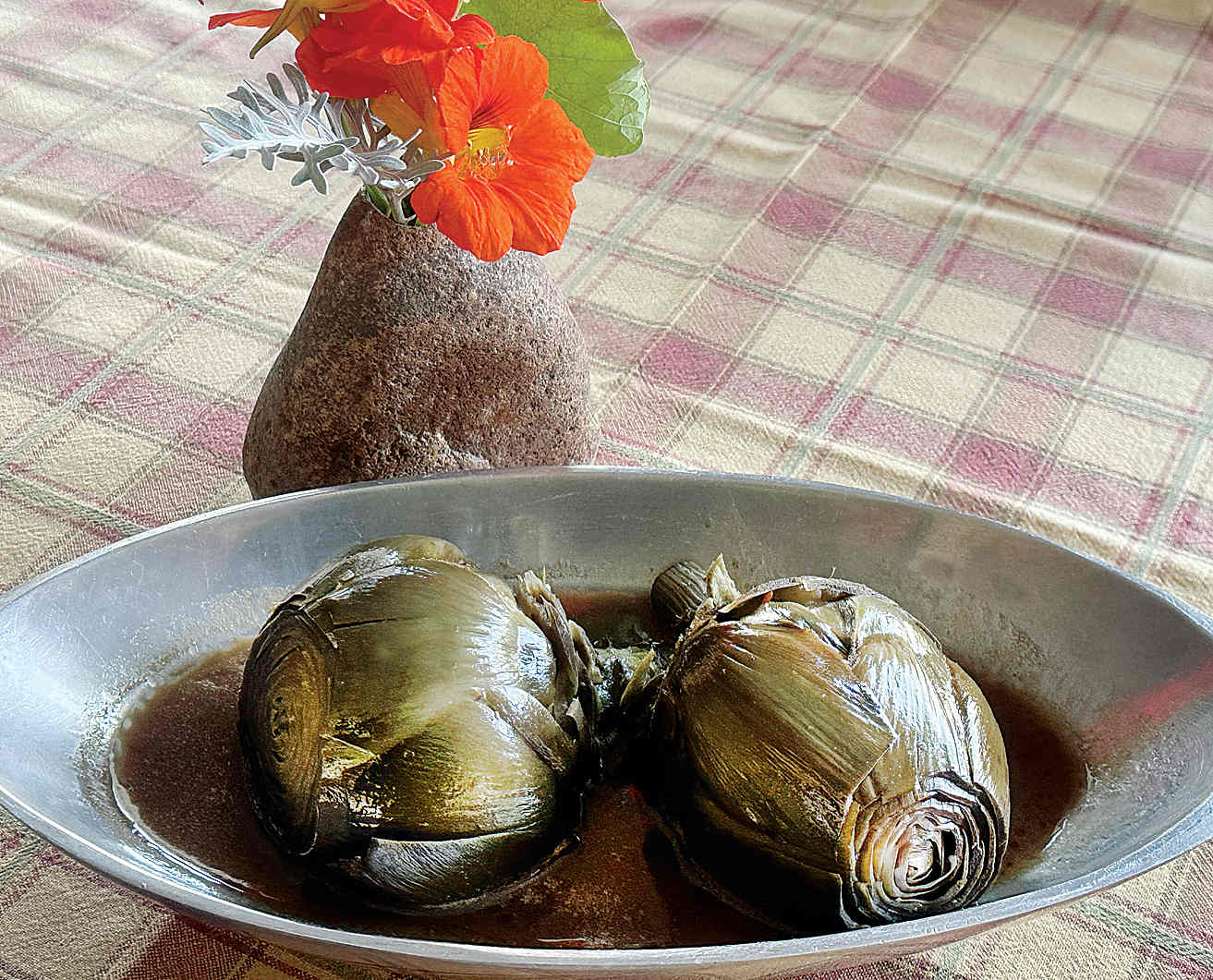
Prepare the artichoke so that it is safe and easy to eat. Leave about 1 inch of the stem or less if you want them to sit by themselves. Pull off the small outer leaves around the base. Cut off about a ½ inch from the top. Cut the spines off the tips of the larger outer leaves. Submerge in water, slosh around, then invert to dry.
Bring 3 cups of water to a boil in a dutch oven or heavy-duty sauce pan that comes with a lid; it should be large enough to hold two to three large artichokes. Add garlic, bay leaves, peppers, chili flakes and salt. Add artichokes, lower heat, put on the lid and simmer over low heat for 20-25 minutes. Turn artichokes over and cover and steam another 5-15 minutes. Coating on the inside of the outer leaves should start to come off between your teeth.
At that point, remove artichokes from pan, set aside and boil down liquid to about 1 1/2 cups. Stir in apple vinegar and honey. Add artichokes and boil for another 15 minutes with the lid off turning once so all sides get coated. The inside coating of the leaves should be soft now. Remove artichokes and keep warm.
Boil down the liquid again to about 1/2-3/4 cup. Strain out leaves, peppers etc. Add butter. Serve alongside artichokes as a dipping sauce.