
Recent Watsonville High graduate Azucena Sandoval spent much of her education learning the fundamentals of science she will study this fall at Stanford University.
But she rarely got to put those concepts into practical use. That changed in late June when she participated in SkyLab, a first-of-its-kind partnership between UC Santa Cruz and Watsonville High School through the K-16 Collaborative.
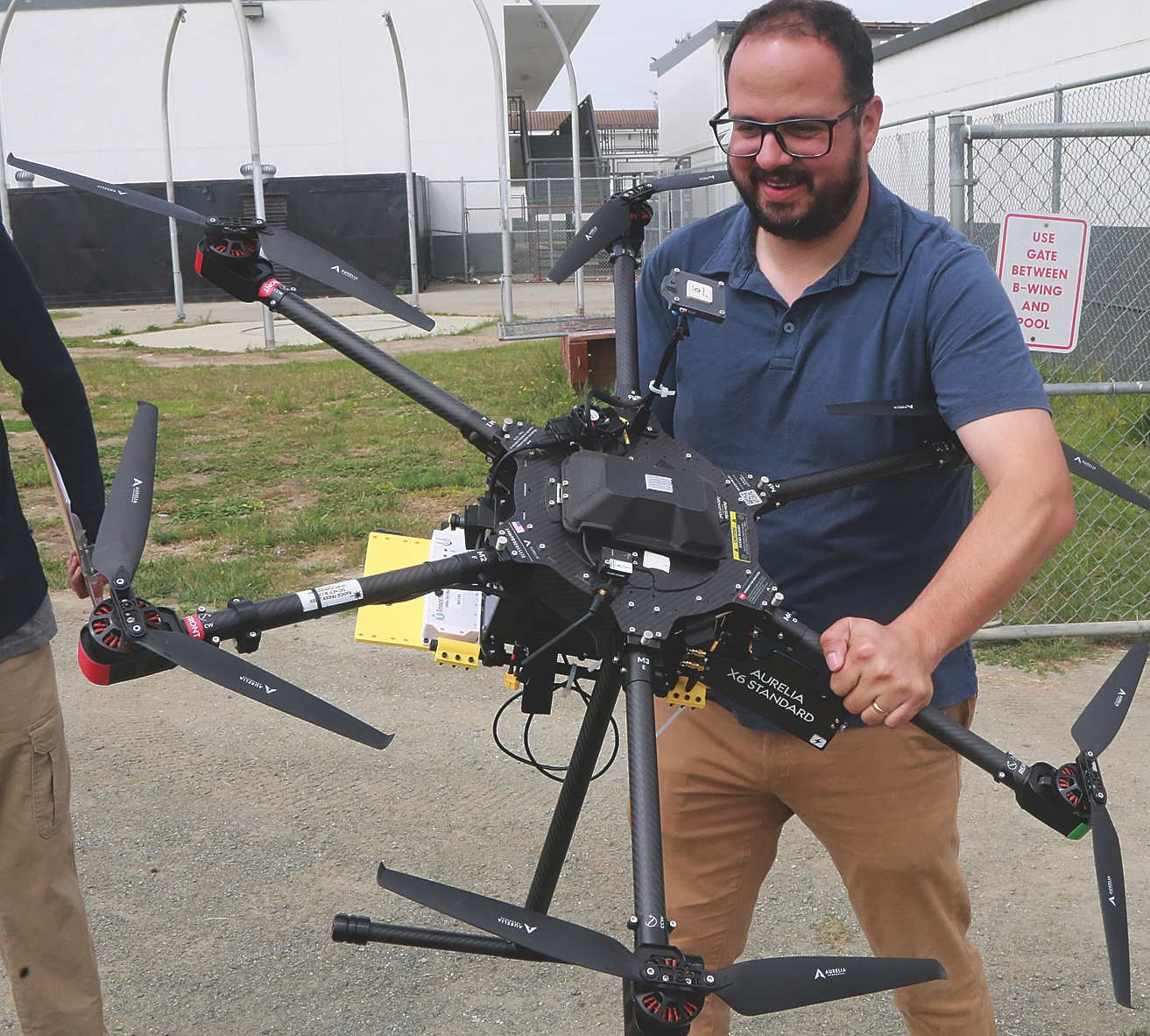
During the two-week course, four students—from sophomores to seniors—designed, built and flew drones above Watsonville to collect real-world data about the atmosphere they experience every day.
“I love learning the fundamentals of science, but when it comes to application, that’s something I felt like I lacked,” she said. “It wasn’t just the conceptual stuff that I’m used to in the classroom.”
Beyond learning engineering skills, the students tackled one of the region’s most pressing issues: understanding how climate and air quality affect the Pajaro Valley.
For assistant professor Javier Gonzalez-Rocha, the program is about much more than teaching students how to build drones.
“It’s really about getting students exposed to science, technology, engineering and mathematics early on and helping them begin developing an identity around becoming an engineer, becoming a scientist, becoming a mathematician,” he said.
They learned computer programming, computer-aided design, 3D modeling, 3D printing and soldering before assembling drones capable of measuring temperature, atmospheric pressure and humidity. By the end of the course, they were flying the aircraft using first-person-view goggles that display a live camera feed from the drone.
“We went from no experience with flying drones to a first-person view,” Gonzalez-Rocha said. “We were surprised. We didn’t know how far we would get.”
Unlike commercially available drones that automatically stabilize themselves in flight, the first-person drones require constant control of altitude, direction and speed, making them significantly more challenging to operate.
The skills are paired with research that has direct relevance to the Pajaro Valley.
The drones collect data about the planetary boundary layer—the lowest part of the atmosphere where people live and work. Understanding how that layer changes throughout the day can help researchers determine how smoke, dust, pesticides and other airborne pollutants move through the valley.
Gonzalez-Rocha said the information could eventually help communities better prepare for wildfire smoke, prescribed burns and other air quality events that affect outdoor workers and residents.
“We’re thinking about climate resilience,” he said. “If there are wildfires, are we prepared to respond? Do we have the information that would enable us to make decisions? Should we go for a run? Should we be outside working?”
The work is especially meaningful in the Pajaro Valley, where geography can cause pollutants to settle in lower elevations.
“If we can measure and really understand how the atmosphere is evolving day to day, we can better understand if there are greater risks of some pollution event impacting the local community,” he said.
For the students, the experience brought classroom lessons to life.
“It was a good introductory experience, and I really liked all the hands-on work that we got,” said 16-year-old Leandro Serrano. “We learned how to solder, how to 3D model, how to do programming, and we also learned how to fly the drones, which was a really cool experience.”
The experience reinforced Serrano’s goal of pursuing engineering in college. He hopes to attend MIT, UCLA, USC or UC Berkeley and major in computer or mechanical engineering.
Jesus Contreras, 17, said he especially enjoyed learning skills that engineers use every day.
“My favorite parts were the 3D printing and soldering because they’re very hands-on,” he said. “I’m trying to get into the engineering field. I want to major in engineering, either mechanical or civil.”
The SkyLab program is part of the broader K-16 Collaborative, a partnership between UC Santa Cruz and Pajaro Valley Unified School District designed to create stronger pathways into science, technology, engineering and mathematics careers.
Although invitations went out to students throughout the district, all four participants came from Watsonville High School. Gonzalez-Rocha hopes future sessions will attract more students as organizers work to reduce barriers such as transportation and scheduling.
He also hopes the program sparks curiosity—not only about engineering, but about the community students call home.
“The students live here,” he said. “They understand these issues because they experience them. This gives them another lens to understand what’s happening around them, and maybe someday help solve those problems.”
The skills are paired with research that has direct relevance to the Pajaro Valley.
The drones collect data about the planetary boundary layer—the lowest part of the atmosphere where people live and work. Understanding how that layer changes throughout the day can help researchers determine how smoke, dust, pesticides and other airborne pollutants move through the valley.
Gonzalez-Rocha said the information could eventually help communities better prepare for wildfire smoke, prescribed burns and other air quality events that affect outdoor workers and residents.
“We’re thinking about climate resilience,” he said. “If there are wildfires, are we prepared to respond? Do we have the information that would enable us to make decisions? Should we go for a run? Should we be outside working?”
The work is especially meaningful in the Pajaro Valley, where geography can cause pollutants to settle in lower elevations.
“If we can measure and really understand how the atmosphere is evolving day to day, we can better understand if there are greater risks of some pollution event impacting the local community,” he said.
For the students, the experience brought classroom lessons to life.
“It was a good introductory experience, and I really liked all the hands-on work that we got,” said 16-year-old Leandro Serrano. “We learned how to solder, how to 3D model, how to do programming, and we also learned how to fly the drones, which was a really cool experience.”
The experience reinforced Serrano’s goal of pursuing engineering in college. He hopes to attend MIT, UCLA, USC or UC Berkeley and major in computer or mechanical engineering.
Jesus Contreras, 17, said he especially enjoyed learning skills that engineers use every day.
“My favorite parts were the 3D printing and soldering because they’re very hands-on,” he said. “I’m trying to get into the engineering field. I want to major in engineering, either mechanical or civil.”
The Skylab program is part of the broader K-16 Collaborative, a partnership between UC Santa Cruz and Pajaro Valley Unified School District designed to create stronger pathways into science, technology, engineering and mathematics careers.
Although invitations went out to students throughout the district, all four participants came from Watsonville High School. Gonzalez-Rocha hopes future sessions will attract more students as organizers work to reduce barriers such as transportation and scheduling.
He also hopes the program sparks curiosity—not only about engineering, but about the community students call home.
“The students live here,” he said. “They understand these issues because they experience them. This gives them another lens to understand what’s happening around them, and maybe someday help solve those problems.”