


Eddie Duino was 8 years old the first time his father brought him to what was then the Watsonville Country Club.
Nearly eight decades later, he still walks the fairways of the same Royal Oaks course, now known as Pajaro Valley Golf Club, teaching the game he has devoted his life to while reflecting on the generations of golfers who have come through its gates.
“My dad brought me here when I was about eight years old,” Duino said. “There’s a lot of history here.”
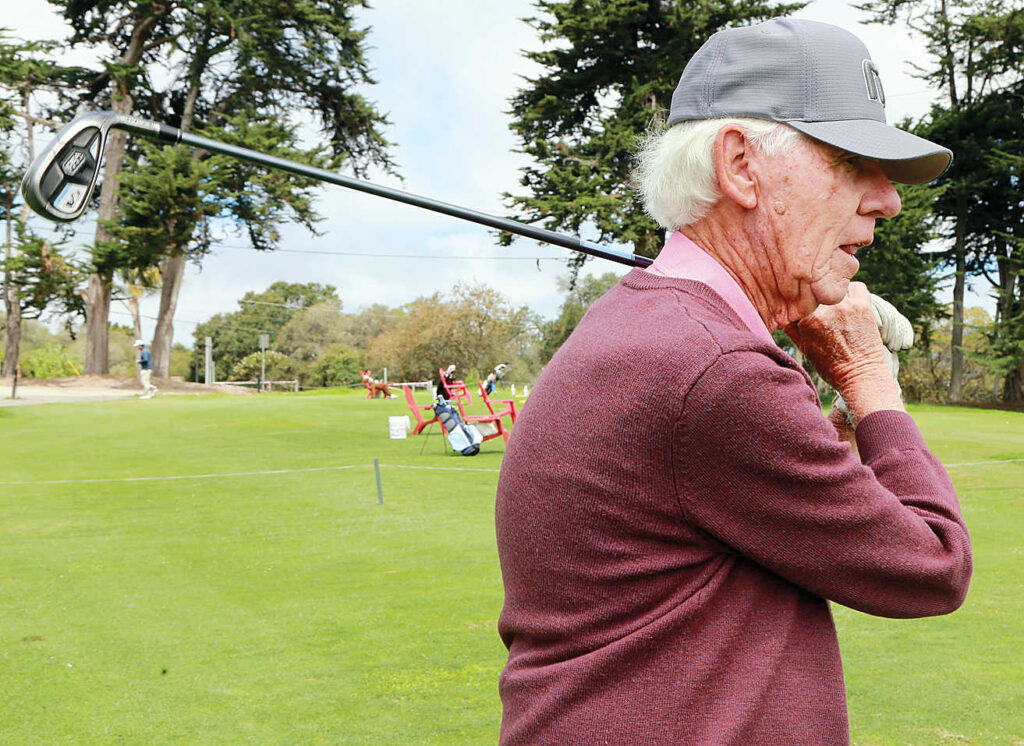
That history reaches a milestone this year as Pajaro Valley Golf Club celebrates its 100th anniversary, marking a century as one of the Central Coast’s oldest golf courses. While the club plans a yearlong series of tournaments and special events through June 2027, perhaps no one embodies its legacy better than Duino, who has spent 65 years as a golf instructor, including the past three decades at Pajaro Valley Golf Club.
For Duino, now in his 80s, the course is more than a workplace.
“It’s like you’re out in a park,” he said. “You’re in the country.”
He has played nearly every course in Santa Cruz County and spent years as the head golf professional at Seascape Golf Club, a place he still speaks fondly of. But Pajaro Valley remains special.
Unlike courses hemmed in by homes and busy roads, Pajaro Valley feels tucked away among oak trees, Monterey cypress and farmland, with views stretching toward Elkhorn Slough.
“You’ll see deer run through here, turkeys, lots of birds,” he said. “It’s got a lot of character.”
Duino also believes the course strikes a rare balance.
“It’s nice enough for a good player—it’s very challenging,” he said. “But for the average player, it’s very user-friendly. It’s got everything.”
That accessibility has helped make the course a destination for generations of local golfers, from beginners taking their first lesson to experienced players returning year after year.
Duino knows many of them by name.
Teaching golf has been his life’s work.
“I must like something about it because I started my career, which I’ve never changed,” he said. “I’ve been at it for 67 consecutive years.”
In the golf business, he said, teaching is often something professionals do after years of running clubs or competing. For him, however, helping players improve has become the most rewarding part of the game.
He still jokes with students, critiques swings and hands out novelty T-shirts proclaiming, “I take lessons from Eddie Duino.”
His enthusiasm has hardly faded.
That continuity mirrors the course itself.
Originally established in 1926, the property began as the Watsonville Country Club. Its first nine holes were designed by Peter Hay, the longtime golf professional at Pebble Beach. Before it became a golf course, the site played an important role in the region’s agricultural economy, serving as Hudson Landing, where barges loaded with produce traveled through Elkhorn Slough before railroads transformed transportation on the Central Coast.
Today, golfers still experience much of the landscape that first attracted visitors a century ago.
“It’s a unique location within the wonderful agricultural context of the Pajaro Valley,” said Mark Swartz, director of operations for the club. “Rolling terrain, mature Monterey cypress and views of the Elkhorn Slough—it is truly a special property.”
Swartz said preserving that character while preparing the club for another century is the guiding philosophy behind its long-term plans.
Those plans include a new clubhouse, restaurant, banquet facility and visitor accommodations, along with environmental improvements designed to reduce water use and protect nearby habitat. The owners are also exploring public trails connecting the property to Elkhorn Slough and hope to permanently preserve 51 acres of resource conservation land bordering the estuary.
The course’s proximity to Elkhorn Slough, one of California’s largest tidal wetlands, has shaped those plans.
“Our approach requires the natural hydrology flow through bioswales that support the creation of additional native habitat while cleansing the water as it moves toward the slough,” Swartz said. “Environmental quality drives our solution-based approach.”
While much has changed since Duino first arrived as a boy, he still remembers the families who built the club.
He attended college with Charles Leiter, whose family owned the course for many years, another thread connecting his own story with the club’s history.
“There’s a lot of history here,” he said again.
Brian Robbeloth, the club’s general manager, believes visitors sense that history almost immediately.
“This course has a unique history and personality that people immediately feel when they arrive,” he said in announcing the centennial celebration. “There’s a sense of authenticity here that has stayed with the property for generations.”
As the club looks toward its second century, Duino isn’t focused on development plans or anniversary festivities.
He talks instead about the feeling golfers get when they step onto the first tee.
Away from traffic, surrounded by open space and wildlife, the course offers something increasingly difficult to find on California’s crowded coast.
For nearly 100 years, generations of golfers have come to Pajaro Valley Golf Club searching for that experience.
Few have appreciated it longer than Eddie Duino, who first arrived with his father as an 8-year-old boy and never really left.