

During President Donald Trump’s first term in office, which began in 2017, his administration proposed a sweeping plan to open nearly all U.S. coastal waters to offshore oil and gas drilling, including 47 proposed lease sales.
Those plans were thwarted amid opposition from local, state and federal officials, as well as residents.
But the threats of offshore oil drilling and seabed mining remain and have grown more dire under Trump’s current administration, in what U.S. Rep. Jimmy Panetta describes as “Trump 2.0.”
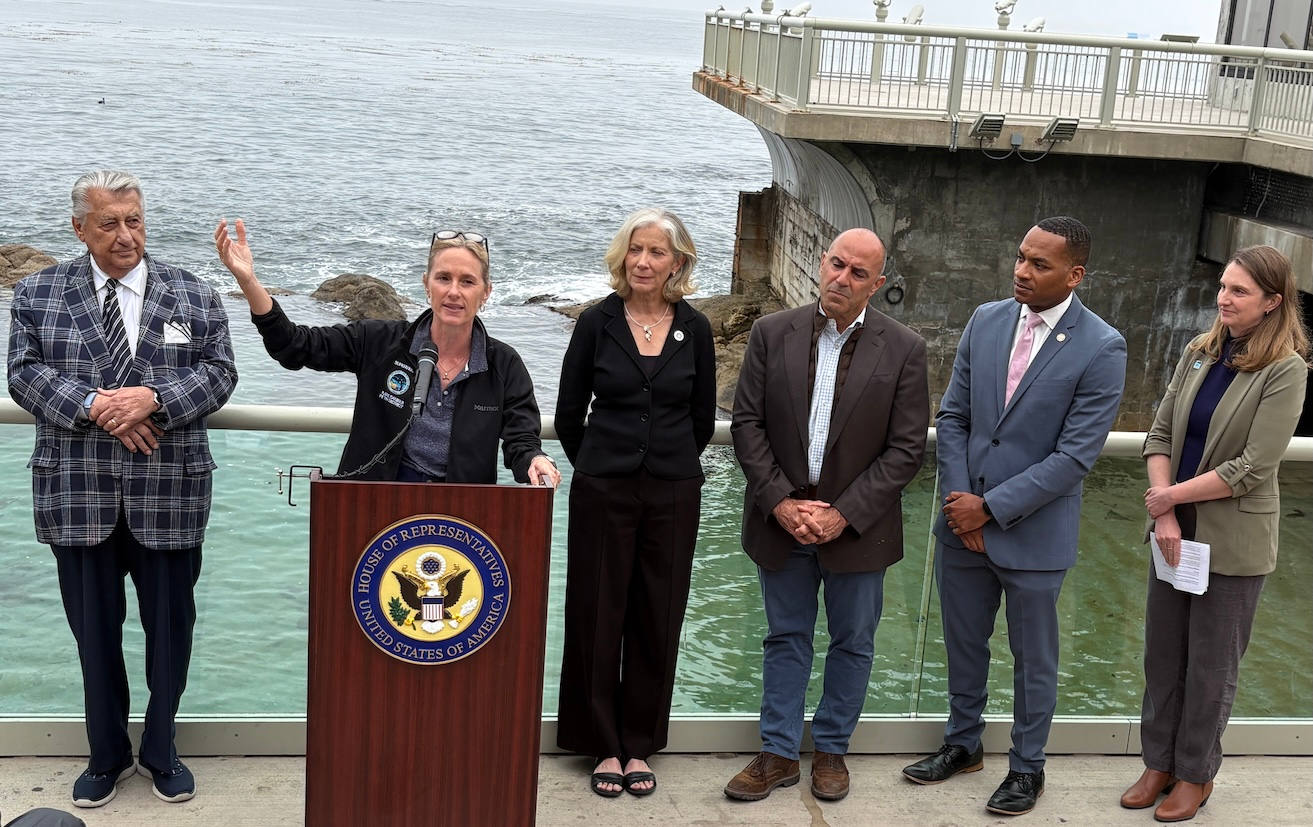
During a news conference Monday morning on the back porch of the Monterey Bay Aquarium, Panetta said the U.S. Department of the Interior recently released a draft proposal making it clear that “all options are on the table” when it comes to offshore oil drilling and seabed mining.
Panetta joined several local elected officials and nonprofit leaders in vowing to continue opposing those plans.
“That’s why we stand here today, with everybody at the table, with all of our options on the table, to let this administration know that our Monterey Bay National Marine Sanctuary will not be the East Wing of the White House,” Panetta said.
Gesturing to a tide pool behind the aquarium, Monterey Bay Aquarium CEO Jenny Gray said children later that day might have their first snorkeling experience in the pristine waters.
“And I think that is why we’re here today,” she said. “To spend a moment thinking about what it is like to put your head under the water and to see the incredible creatures that live in our ocean.”
Panetta told the crowd that, with the “chaos and the craziness and the uncertainty and some absurdity coming out of Washington, D.C.,” it can be easy to become disheartened and divided.
But Panetta pointed to Federal Register records showing that more than 300,000 people opposed the previous plans during the public comment period.
“We stand at the ready to do it again when the next comment period occurs, once the administration releases the updated plan,” Panetta said. “And we must continue to engage. We must continue to unite. And, yes, we will continue to fight as we stand up to protect our coastline.”
Monterey County Supervisor Kate Daniels said an accident during drilling could cause catastrophic damage.
“… we know collectively that one oil spill threatens everything,” she said. “It’s not just the ocean behind me, but it is the economy, it is the food that we eat, and it is the place that so many people have the opportunity to come and visit and experience.”
Ted Balestreri, CEO and chairman of the Cannery Row Co., agreed, saying such a disaster would severely affect Monterey’s tourism industry, which draws 6.3 million people annually.
That includes the hospitality industry, he said.
“I want you to know this is what the industry of America is all about,” he said. “And to impede it, to put oil drilling out here, it’s like destroying the Mona Lisa.”
Save Our Shores Executive Director Katie Thompson said her organization is ready to fight drilling off the coast, as it did four decades ago when it was formed to fight federal offshore drilling proposals.
Thompson said the federal government is proposing new offshore oil and gas development, including six lease sales off California, two of them on the Central Coast.
“… We fought it back then, we won and we’re ready to fight again,” she said. “Californians have made the position clear. We do not want offshore drilling.”
The state is already strengthening its so-called “Blue Wall,” a series of local ordinances along the coast intended to hinder offshore oil drilling.
That includes Assembly Bill 1448, which, if signed by Gov. Gavin Newsom later this year, would prohibit oil companies from using existing land-based infrastructure to support new offshore oil extraction.
Currently, state law prohibits oil companies from building new infrastructure for that purpose.
Ashley Blacow-Draeger, Oceana’s Pacific policy and communications manager, called the pending legislation “a critical piece of legislation that will help fortify California’s coastline from the escalating risks of expanded offshore oil and gas drilling.”
Janine Chicourrat, managing director of the Portola Hotel & Spa, said she remembers swimming in the ocean as a child in Southern California — where offshore drilling occurs — and having to clean oil from her body that had leaked from offshore oil operations.
Chicourrat called the idea of offshore drilling on the Central Coast an “absolutely ridiculous concept” that would decimate the fishing industry, decrease property values, cause spills and damage the fragile ecosystems at attractions such as Point Lobos State Natural Reserve.
“We’re made up of a lot of small businesses, and that would kill us,” she said.