

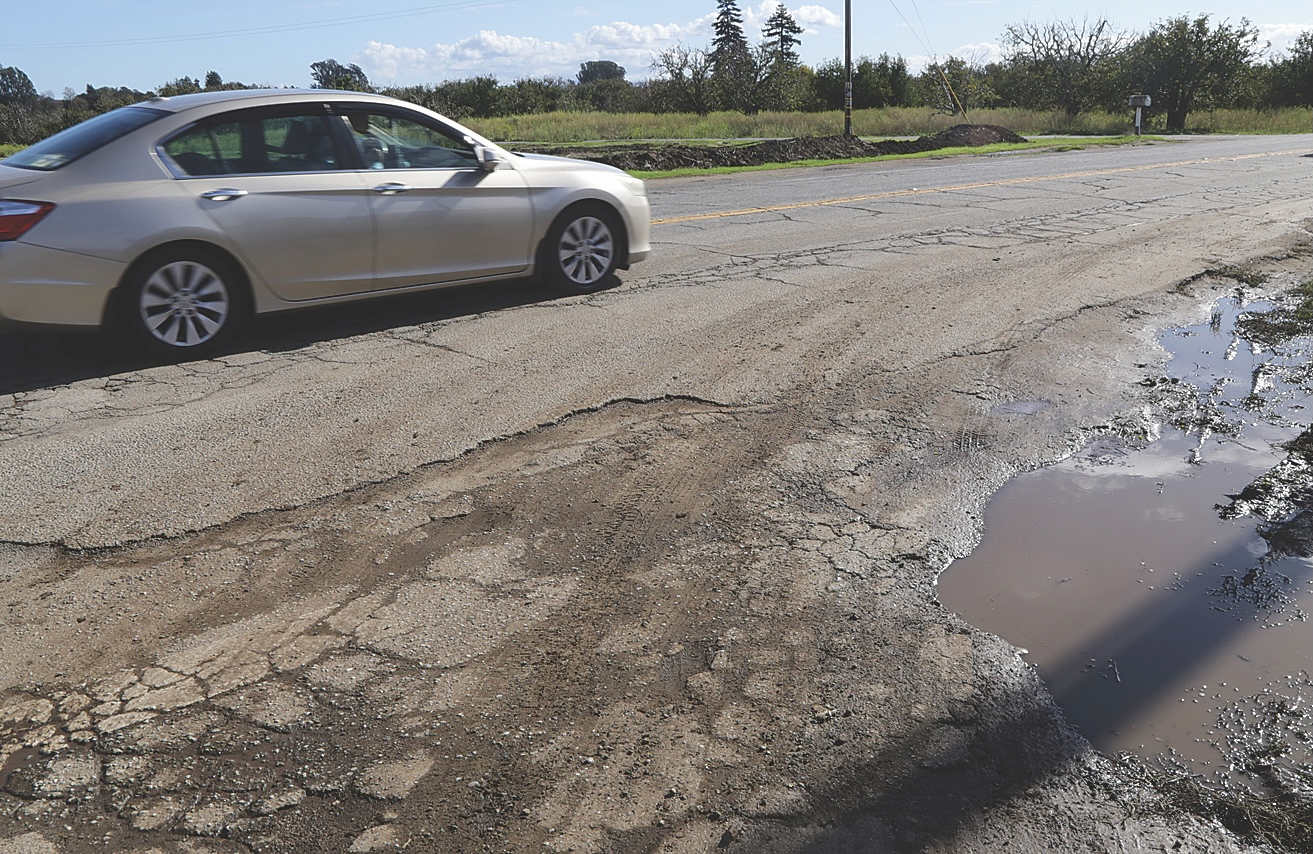
Santa Cruz County supervisors on Tuesday declined to adopt an ordinance that would dedicate 5% of discretionary General Fund revenue to road maintenance, instead calling for further analysis of how the proposal would affect other county services.
The Nov. 17 decision came after residents described deteriorating mountain roads, washed-out sections and concerns that damaged roads could prevent them from escaping wildfires or reaching emergency services.
Supervisor Manu Koenig proposed the Safe and Resilient Roads Ordinance, which would allocate approximately $11.47 million annually to road maintenance, compared with roughly $2 million currently provided through the General Fund.
The proposal would redirect approximately $9.47 million annually from money otherwise available for county operations.
Rather than approve the ordinance, supervisors agreed to refer the proposal for further study by the county’s road funding ad hoc committee, comprising Supervisors Kim De Serpa and Monica Martinez.
The committee will examine the financial implications and potential effects on other services, with a report expected at the board’s second meeting in February 2027.
The decision followed a Nov. 10 meeting at which supervisors unanimously agreed to explore additional funding sources for road maintenance.
A county study identified a road maintenance backlog of approximately $294 million that could grow to $683 million by 2035 without additional investment.
During public comment Tuesday, several residents said the problem goes beyond potholes and deteriorating pavement.
Susan Tatsui-Darcy, leader of North Rodeo Gulch Firewise, which represents 300 households, said sections of the six-mile county road have deteriorated from two lanes to one.
“Imagine 600 people trying to evacuate while fire engines and emergency vehicles are coming up that same road,” she said. “Our roads could become death traps.”
Tatsui-Darcy urged supervisors to support Koenig’s proposal, saying reliable funding is necessary to restore roads, repair failing culverts and maintain evacuation routes.
“Our roads are not just transportation corridors, they’re lifelines,” she said.
Mariana Mejia, 82, said she fears that additional storm damage could leave her and her 88-year-old sister-in-law isolated.
North Rodeo Gulch Road is their only access for food, medical supplies and other necessities, she said.
“So, I’m worried about being cut off from food, medical supplies in the El Nino storm, and if we survive that, then we have the summer of fires,” Mejia said.
Jim Starr, who lives off Rodeo Gulch Road, urged supervisors to prioritize reopening damaged roads before making improvements elsewhere.
“Your constituents are depending on you to work together on this and leave no one in the county trapped in an emergency,” he said.
Similar concerns came from residents of Mountain Charlie Road, where storm damage has restricted access.
Mary Crenshaw said a major slide in 2024 left her neighborhood with only one evacuation route.
“Since then, my biggest fear is being trapped between two slides and having zero ways out,” she said.
Crenshaw urged the county to take a proactive approach to maintenance rather than waiting for roads to fail.
“Besides being a much cheaper way to deal with the problem, this approach could literally save lives,” she said.
Cassandra Maws, who lives off Mountain Charlie Road, described damage to Redwood Lodge Road that has left residents with limited access.
She said repairs to the road and a damaged bridge could cost millions of dollars.
Scott Delva of Mountain Charlie Firewise challenged the idea that funding roads necessarily comes at the expense of public safety and human services.
“Safe roads are how people get to those services and how caregivers get to the places where their clients are,” he said.
Wendy Mathias, a longtime Cox Road resident and leader of a neighborhood Firewise group, described a dangerous washout, deteriorating pavement and the possibility that an emergency vehicle could leave the roadway.
A retired nurse practitioner, Mathias compared preventive road maintenance to preventive health care.
“I know that in health care, the prevention dollar goes so much further than a treatment dollar,” she said.
The supervisors’ decision leaves the proposed funding requirement unresolved while the committee examines its potential impact on the county budget.
The county has also been exploring other revenue sources, including possible taxes and additional state and federal funding.