

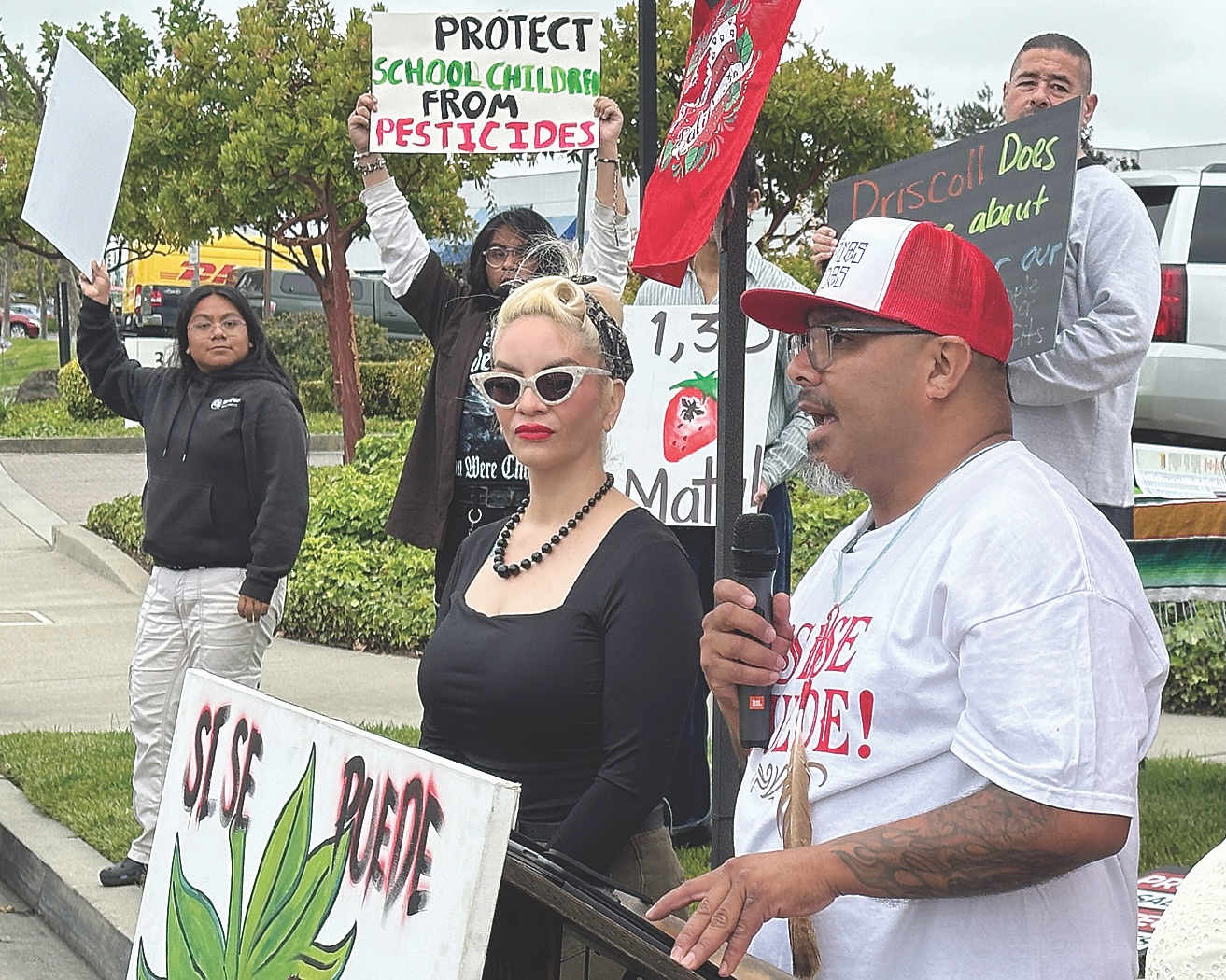
Farmworker advocates, parents, educators and environmental activists gathered Wednesday outside Driscoll’s Watsonville headquarters to call for stronger protections against pesticide exposure near schools, arguing that children in the Pajaro Valley face disproportionate health risks from agricultural chemicals.
The news conference, arranged by community organizer Omar Dieguez, coincided with the release of a report titled “Pesticide Use in the Pajaro Valley: Harmful and Disproportionate Amounts by County, School District, and Race.” The report cites state pesticide-use data and academic studies linking certain pesticides to cancer, asthma and developmental problems.
“Today, we stand together with farmworkers, parents, students, teachers, health professionals, environmental advocates and community members because enough is enough,” Dieguez said. “Protect our children, protect our farmworkers, protect our air, protect our water, protect our land.”
Organizers called on growers to stop using highly hazardous pesticides near schools and urged the Santa Cruz County Agricultural Commissioner to expand school pesticide buffer zones from the current quarter-mile to one mile.
According to the report, more than 95% of pesticides linked in scientific studies to childhood cancer that are applied in Santa Cruz County are used in and around Watsonville and much of South County. The report also states that Pajaro Valley Unified School District has the highest use of the fumigant chloropicrin of any school district in California, and that more 1,3-dichloropropene, another fumigant, is applied within district boundaries than in any other California school district.
Dieguez said residents have grown frustrated with assurances from regulators and agricultural companies.
“For too long, our families have been told not to worry. For too long, our concerns have been dismissed,” he said. “But we are not imagining what we see. We see the fields next to our schools. We see the pesticide notices.”
The report cites National Cancer Institute data showing Santa Cruz County has one of the highest overall cancer rates in California. Organizers argued that the county’s heavy pesticide use may be contributing to those outcomes, though they acknowledged the report does not establish direct causation.
Maria Ortiz of the Watsonville Brown Berets pointed to countywide cancer and asthma statistics while urging state regulators to phase out certain pesticides.
“We are not claiming that elimination of these pesticides will save our cancer, lung and brain problems,” Ortiz said. “But we do think that it’ll help, maybe even a lot.”
Among the speakers was Pajaro Valley Unified School District Trustee Gabe Medina, who delivered an emotional address focused on the personal toll cancer has taken on his family.
“My nephew, a little boy, beat childhood cancer,” Medina said. “My tía beat cancer. This year, another member of my family received a new diagnosis, liver cancer. Cancer is not a stranger in the Pajaro Valley. Cancer is a neighbor. Cancer sits at our kitchen tables.”
Medina cited findings from UC Berkeley’s long-running CHAMACOS study and other research linking pesticide exposure to developmental and neurological impacts in children.
“When our communities wonder why our young adults wrestle with ADHD, ADD, dyslexia, anxiety, why parents wrestle with cancers we cannot pronounce, the answer is no mystery,” Medina said. “The answer is in the air at six in the morning when the spray rigs roll before the school bell rings.”
Medina called for a one-mile pesticide-free zone around schools, stronger notification requirements and greater accountability from agricultural companies.
“So Driscoll’s, don’t tell me you care. Show me,” he said. “Show me with the buffer zones. Show me with a written commitment to phase out organophosphates from your supply chain.”
Watsonville resident and Cabrillo College student Araceli Gonzales described receiving notices warning residents to remain indoors during nearby pesticide applications. Her daughter attends Amesti Elementary School.
“I’m worried about the air quality our children are getting,” Gonzales said. “I’m worried about the air quality I’m getting after being diagnosed with asthma and all sorts of allergies just a year ago.”
Gonzales said state pesticide records show thousands of pounds of toxic air contaminants have been applied within a one-mile area surrounding her daughter’s school during the past seven years.
“As a mother, I’m also worried about the 8,407 pounds of cancer-causing pesticides and the 856 pounds of brain-harming pesticides that have been applied in this one-mile square where my family has lived and gone to school,” she said. “I feel like I’m letting my children get poisoned just by breathing the air.”
The report frames pesticide exposure as an environmental justice issue, noting that the Pajaro Valley is home to much of Santa Cruz County’s Latino and indigenous population.
Advocates also challenged comments made in a recent newspaper advertisement by Driscoll’s Vice Chair Brei Reiter Smith, who called for discussions about pesticides to be guided by the best available evidence.
The protest organizers’ recommendations include expanding school buffer zones, increasing public notification requirements for pesticide applications and phasing out fumigants and organophosphate pesticides.
In a statement issued the day of the event, Driscoll’s disputed claims that local berry farming has been shown to cause elevated childhood cancer rates and pointed to recently updated information from the Santa Cruz County Health Services Agency.
According to the company, the county’s review found that “childhood cancer rates in Santa Cruz County were not significantly higher than rates seen across California” and that a focused review of South County, including the Pajaro Valley, “did not find a statistically significant increase in childhood cancer in the region during a five-year study period.”
Driscoll’s said overall cancer cases observed in South County were consistent with what would be expected based on population size and established cancer rates. The company noted that while countywide childhood cancer rates have been higher than state averages over five- and 10-year periods, rates in the Pajaro Valley are close to the statewide average.
“For weeks, our community has heard claims that local berry farming is responsible for elevated childhood cancer rates,” said Soren Bjorn, chief executive officer of Driscoll’s. “The County’s update is important because it helps set the record straight. At the same time, it leaves an important question unanswered: Why are childhood cancer rates higher across Santa Cruz County overall?”
Bjorn said families deserve more information about what may be contributing to childhood cancer rates countywide.
“The public deserves to know more about what is actually happening with regard to this deeply concerning situation in our county,” he said. “Families deserve answers to that question.”
Driscoll’s emphasized that its independent growers operate within a regulatory system overseen by federal, state and local agencies, including the U.S. Environmental Protection Agency and California Department of Pesticide Regulation, with workplace safety requirements enforced by Cal-OSHA.
The company said it supports continued discussion grounded in scientific evidence and public health data.
“Our community is at the center of this conversation,” Bjorn said. “We’ve listened carefully and take these concerns seriously. This is where my family lives and where many of our growers and employees have built their lives. Conversations about children’s health are deeply personal, and families deserve compassion and clear, accurate information.”







According to the company? According to UCSF and CDPH, childhood cancer rates in Santa Cruz County were not significantly higher than rates seen across California. County rates of cancer were highest among non-Hispanic White children in some years, a trend that mirrors state and national rates. A focused review of South County also did not find a statistically significant increase in childhood cancer in the region during a five-year study period.
What happened to unbiased journalism, Todd? Why aren’t the facts from Santa Cruz County’s Public Health report being reported?