

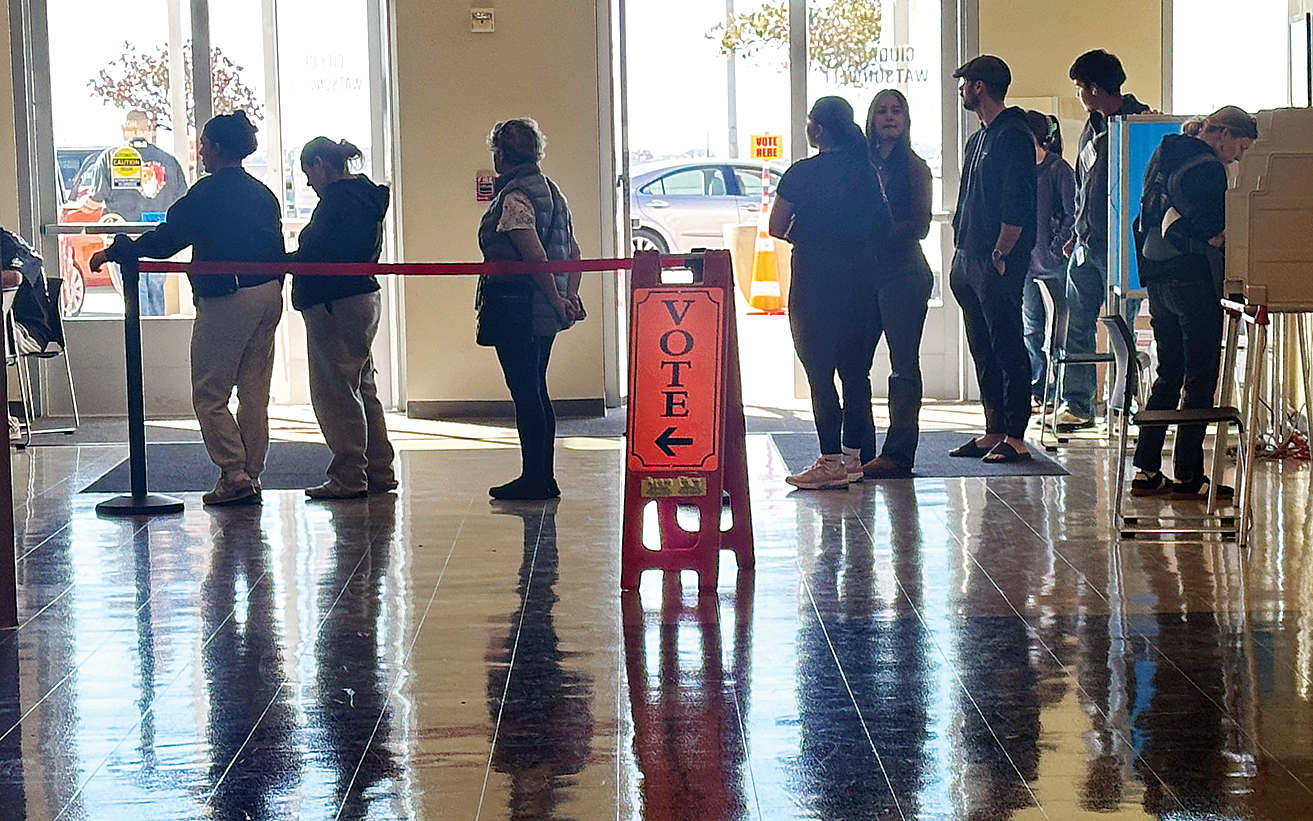
Measure E, the temporary half-cent sales tax on non-essential goods is in the lead with 59.4% as of Thursday at 6pm, with 48.3% of votes counted according to the Santa Cruz County Elections Department.
The measure is a countywide tax that would generate revenue for county services affected by federal budget cuts, such as emergency medical services, community health clinics, food assistance and more. If passed, the measure would take effect April 1, 2027, and last until April 1, 2032.
The tax is expected to raise $6.75 million in the 2026-2027 fiscal year and $27 million annually thereafter, according to an impartial analysis by County Counsel Jason Heath. It is expected to raise $135 million for county services over its five-year course.
Revenue is intended to help mitigate the damage of the federal budget cutbacks resulting from H.R. 1, a federal law from last July that changes federal spending for health care and welfare programs.
The law, commonly referred to as President Trump’s One Big Beautiful Bill, is expected to create a $200 million annual loss in funding for community services such as CalFresh in Santa Cruz County.
Many local organizations expressed their support for Yes on E, including Santa Cruz Community Health, Watsonville Community Hospital Foundation, Pajaro Valley Health Care District, Community Action Board, Community Bridges and more.
CEO Anita Aguirre said Santa Cruz Community Health was an early endorser of Measure E and that the health clinic is excited about the current standings.
“We see the impact that H.R. 1 … is going to have on our safety net system, so it really felt important that local communities generate some local control over where we are helping to backfill those losses,” Aguirre said.
The organization hopes to work closely with the county to help determine local areas for investment.
Opponents of the measure criticized the tax increase, saying it is the third time since 2018 that the Board of Supervisors placed a half-cent sales tax on the ballot with broad promises.
Measure G from 2018 and Measure K from 2024 increased the sales tax in unincorporated areas, the former to fund road repairs and fire protection and the latter to address housing, homelessness and parks infrastructure. After a lawsuit in 2024, the county agreed that revenue from Measure K and the remaining Measure G revenue would be spent exclusively on services in unincorporated parts of the county.
Aptos resident Becky Steinbruner spoke against Measure E at a Pajaro Valley Health Care District board meeting on Oct. 28. She pointed out the lack of a guarantee on how the money will be spent, as generated revenue will be deposited into the county’s General Fund.
“I have heard promises and I have seen them broken over and over again,” Steinbruner said. “…This will hurt people who can least afford it.”
The measure would apply to everyone making purchases in the county—residents and tourists alike. Sales tax in Santa Cruz, Scotts Valley and Watsonville would jump from 9.75% to 10.25% if the measure passes. In unincorporated Santa Cruz, that number goes from 9.5% to 10% and in Capitola, 9.25% to 9.75%.
The tax would not apply to groceries, diapers, medications, feminine hygiene products and other essential items.
State Propositions
Prop 3: Ahead with 59.1%
Californians likely voted to pass Proposition 3, which amends the California Constitution to add the existing voter-approved tax rates for individuals earning over $371,000 or joint filers earning over $742,000, adjusted annually for inflation. The measure appears certain to pass.
Prop. 3 applies to about 2% of California’s population and would maintain the $5 billion to $15 billion of annual state income tax revenue generated by the state.
Prop 38: Ahead by 55.3%
55.3% of Californians cast their vote to authorize an $8.4 billion general obligation bond for immunology and immunotherapy research which targets diseases such as cancer and Alzheimer’s disease.
If passed, the proposition would direct half of the $8.4 billion to a single UC-affiliated nonprofit medical research institute and half to both public and nonprofit research grants.
Prop 40: Behind 45%
The controversial Billionaire Tax that dominated airwaves this season lags behind in the polls, with 55% voting no.
The 2026 Billionaire Tax Act would create a one-time 5% wealth tax on taxpayers with over $1 billion in assets—about 250 people—with 90% to be spent on public healthcare and the other 10% on education, food assistance and administrating the tax.
Prop 41: Behind 47%
47% of Californians are signaling opposition to this proposal, which would require audits of new tax programs that would make it harder to pass new special taxes by requiring review before going to voters.
If passed, this would directly conflict with Prop. 40, which is also behind in the polls.
Prop 42: Ahead by 53.7%
53.7% of Californians are in support of the proposition that would prohibit new taxes on the ownership of assets such as investment accounts, business interests and personal property. These are assets that are typically only taxed when they are sold or generate income and would nullify Prop. 40, which is behind in the polls, if it passes.
Prop 44: 81.9% voting no
An overwhelming majority voted against the ballot measure that would require nonprofit community health clinics to spend 90% of revenue on program services.
Most of the votes are against the proposition that Santa Cruz County Health estimated would cost the county $2.47 million based on its 2023 tax filing.
•••
Syd Fluker is a California Local News Fellow. Visit fellowships.journalism.berkeley.edu/cafellows.