

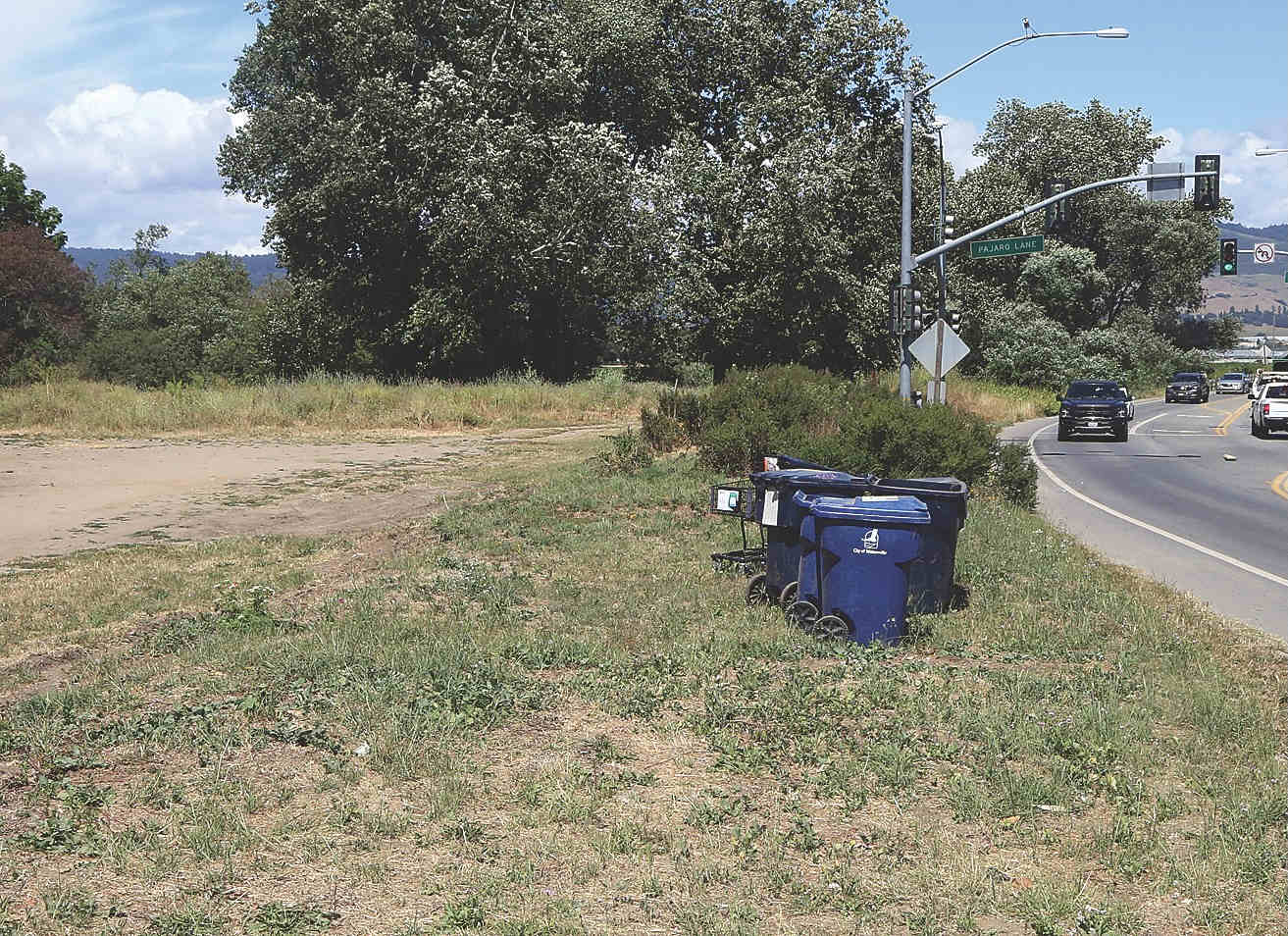
The vacant 2.75-acre property on Airport Boulevard across from the Freedom Centre shopping plaza has long been the site of a homeless encampment that troubled residents and plagued city officials, who struggled to balance helping unhoused residents with protecting the land from the impacts of unsanctioned camping.
Now, after years of asking the property owner KDS Dhaliwal Investments Inc. to keep the property along Corralitos Creek clean—and paying thousands to clean it themselves—the city has taken ownership of the property, and has plans to develop it into a park.
On Tuesday, the Watsonville City Council accepted the donation of the land following negotiations over cleanup costs and ongoing encampment issues.
The city previously spent about $145,760 clearing a homeless encampment from the site in 2024, and had threatened to place a special assessment lien on the property if those costs were not repaid.
Under the proposed agreement, the company will pay the city $60,000 toward past cleanup expenses, remove the current encampment and then transfer the property to the city.
City officials said the parcel would be accepted in “as-is” condition. The owner would also indemnify the city against claims arising from clearing the encampment.
While no funding has been identified to create a park on the property, Deputy City Manager Nick Calubaquib told the council that there may be funding from Proposition 4, a 2024 law that, among other things, invests in state and local parks.
The report states the city would not pay a purchase price and would only be responsible for its share of escrow-related costs.”
Additional details in the proposed land donation agreement show the property owner must meet several conditions before the transfer to the city of Watsonville can be completed.
The agreement requires KDS Dhaliwal Investments Inc. to remove the encampment and hazardous materials — including biohazard waste, chemical waste, human waste and used needles—before escrow can close.
The city would retain the right to inspect the site and require additional cleanup if necessary.
The owner also must comply with environmental laws and due process protections related to the removal of unhoused people and personal belongings from the property.
Escrow would be handled through First American Title Company in Soquel, with the transfer expected to close after June 1.
Councilman Jimmy Dutra worried that the residents will move back onto the property after it has been cleared.
“My concern is that it turns back into what it was, and the public does not want to see that,” he said. “The damage that it has put upon Safeway and that shopping center is something the public does not want to go back to.”
Calubaquib told the council that the Parks and Recreation department will manage the property.
“The goal is to create a safe space that doesn’t fall back to the encampment,” he said.
Councilwoman Maria Orozco called the donation a “neat opportunity.”
“District 3 lacks parks, so I am excited for the potential,” she said, adding that long-term management should be shared between the city and Santa Cruz County, on whose boundaries the property lies.
“I think it has to be a mutual collaboration to make sure that we can more consistently address the issues that arise in that area,” Orozco said.
•••
New utility rates approved
In separate action, the council approved a series of utility rate increases for water, wastewater and solid waste services that city officials say are necessary to maintain aging infrastructure, comply with new environmental regulations and pay for major capital projects.
The increase—the city’s first since 2021—will take effect July 1.
Residential water customers will be billed under a three-tier system based on usage levels.
Customers with fixed meters will see monthly charges rise from $29.93 to $32.16.
Customers in the first tier using up to 6 hundred cubic feet of water per month would see rates increase from $4.11 to $4.32 per unit. Second-tier users consuming between 7 and 12 hunderd cubic feet would see rates rise from $5.38 to $5.50.
Customers who use more than 12 hundred cubic feet per month would initially see rates drop from $8.33 to $7.58 before gradually increasing over the following years to $9.21 by 2031.
City officials said the increases are needed to address inflation-driven operating costs, maintain reserve funds and debt obligations, and fund large infrastructure investments. Because the city’s utilities operate as enterprise funds, the services are paid for through customer rates rather than taxes or the city’s general fund.
According to the rate study presented to the council, the water system faces about $85 million in capital projects through 2031. Among the largest projects are a new Chromium-6 treatment plant and ongoing water main replacement programs.
Officials said new state drinking water regulations for Chromium-6, along with aging wells and pipelines and rising costs for labor, chemicals and utilities, are driving the need for higher water rates.
The study warned that without the increases, the city’s water enterprise fund would fall below reserve targets by 2029 and enter a negative cash position by 2031.
Wastewater projects account for some of the steepest proposed increases. The city plans roughly $86.6 million in wastewater capital spending through 2031, including a $40 million replacement of the wastewater treatment plant’s headworks and influent pump station.
Another major investment is a $20.4 million cogeneration and energy savings project that officials estimate could reduce Pacific Gas & Electric costs by more than $800,000 annually.
Both measures passed 6-0, with Vanessa Quiroz-Carter absent.








That’s weak. The owner shouldn’t have get rid of his property. The homeless/drug-addict problem is not his problem. It’s a city problem or society problem. That’s Bs. They should pay him market price for that property at least.
$145 thousand in 1 year?! Over $3,000 a week? Over $500 a day? How?
The owner didn’t have to give up the property; he voluntarily transfered title to the city because he didn’t want to pay to develop the property or at least put a fence around it to discourage trespassing. Ownership doesn’t mean you get to let your property lapse into disrepair and become an attractive nuisance.
The homeless drug zombies living there are not held responsible for creating a mess to the environment with the junk they collect, and pollution created to creak is shameful. It somehow became the responsibility of the taxpayer and property owner to shoulder the cost.
It looks like the property owner bought land cheaply, then hoped to pressure the city to rezone it so it would be worth more. I am surprised that the city didn’t cave on this one.