
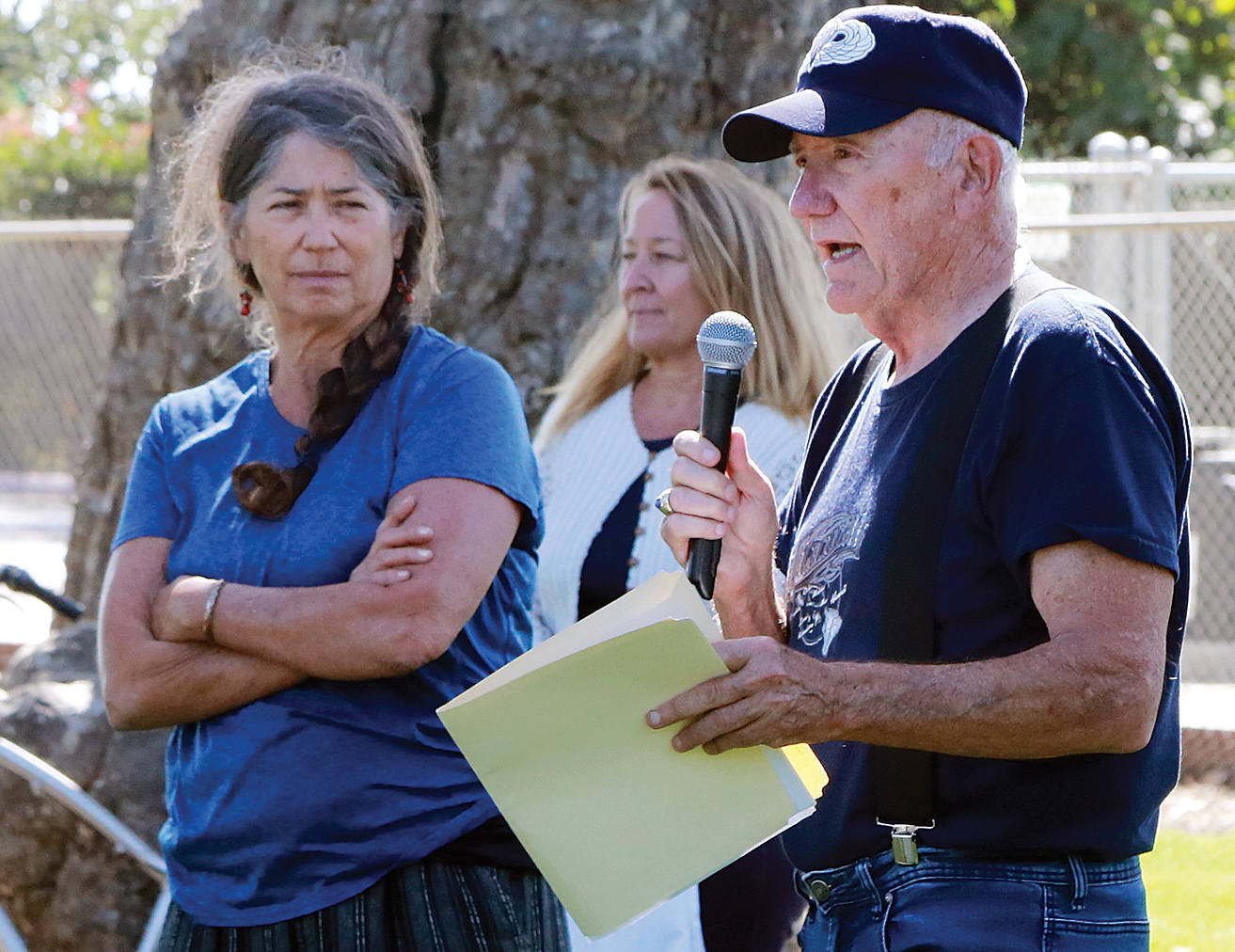
About 75 people gathered at Pinto Lake City Park on Oct. 10 to voice concerns and opposition to a proposed Battery Energy Storage System (BESS) in Watsonville, a facility opponents say could be as large as 10 football fields.
Organizers described the proposed facility at 90 Minto Road as a fire and safety hazard for nearby residents.
Community organizer Phoenix Artemisia said the site could house more than 200 shipping container-sized battery units.
Invenergy, a Chicago-based energy developer, took over the project, called the Seahawk Energy Storage Project, on Aug. 26.
Invenergy has said it expects the California Energy Commission’s permitting process to conclude by the end of 2027.
“We recently sent a mailer with a stamped envelope to 100 addresses closest to 90 Minto, and apparently it really helped people to take action,” Artemisia said.
Artemisia questioned Invenergy’s plans to use lithium iron phosphate (LFP) batteries, arguing that the technology still presents fire risks.
“Lithium iron chemistry is no longer new technology, nor is it necessarily safer,” Artemisia said.
Pointing to a Sept. 18 battery fire at Moss Landing and another Sept. 21 in La Verne, Artemisia questioned why the company was not considering sodium-based batteries.
“Why won’t Invenergy get away from lithium and use nonflammable sodium battery chemistry?” Artemisia said. “Why won’t our county ban lithium battery storage?”
Artemisia also raised concerns about earthquakes, noting that the San Andreas Fault runs a few miles east of Watsonville.
“If they must have their BESS in Watsonville, why can’t Santa Cruz County lead by protecting people and the environment with a sodium battery chemistry?” Artemisia said.
Becky Steinbruner told the crowd that Seahawk’s developers sought approval through the California Energy Commission rather than the county.
“This is putting them through a much more rigorous process than they ever would have had here at the county,” she said. “The state has been much more rigorous than the county ever would have been, and our voices and written comments are now being loudly heard at the state level.”
Steinbruner said public opposition has prompted the commission to consider additional requirements for battery storage projects, including documentation of property agreements, consultation with local fire departments and potential community benefits.
Ed Mitchell of Never Again Moss Landing said residents who participated in a county health survey following the massive Jan. 16, 2025, fire at the Moss Landing battery storage facility reported a range of symptoms.
“They ranged from minor to major,” Mitchell said.
Mitchell said the smoke that spread across the region raised questions about the potential health effects of battery fires.
“The downwind proof says that there was something dangerous in that cloud,” he said.
Mitchell urged residents to ask local fire officials to require equipment capable of measuring potentially hazardous substances released during battery fires.
Supervisor-elect Tony Nuñez also addressed the crowd, discussing Invenergy’s plans to replace batteries originally proposed for the project.
“It’s a step in the right direction, but it doesn’t solve everything,” Nuñez said. “We don’t know yet who will make the new batteries or how this is going to affect the project with cost, design and obviously safety for our community.”
Nuñez highlighted recent state legislation, including Senate Bill 283, that he said would give local firefighters a stronger role in reviewing battery storage projects.
“Companies must meet with local fire departments before applying for approval and address safety concerns,” Nuñez said. “Fire officials also have a role in inspections before the facility opens.”
Nuñez said the local fire protection district was not properly consulted during the project’s initial development.
He also discussed the possibility of requiring community benefits from battery storage developers, including jobs, tax revenue, road improvements and funding for schools, firefighters and emergency services.
“I will continue to meet with CEC representatives and folks on the board as well to continue to show them who the Pajaro Valley is and who is around this project and who is going to be affected,” Nuñez said.
He encouraged residents to remain involved in the permitting process.
“Our community can continue to organize, our community can continue to talk to folks at the CEC and continue to tell our story and why we don’t want this in our backyard,” Nuñez said. “I think most importantly, we have a little bit of time.”