
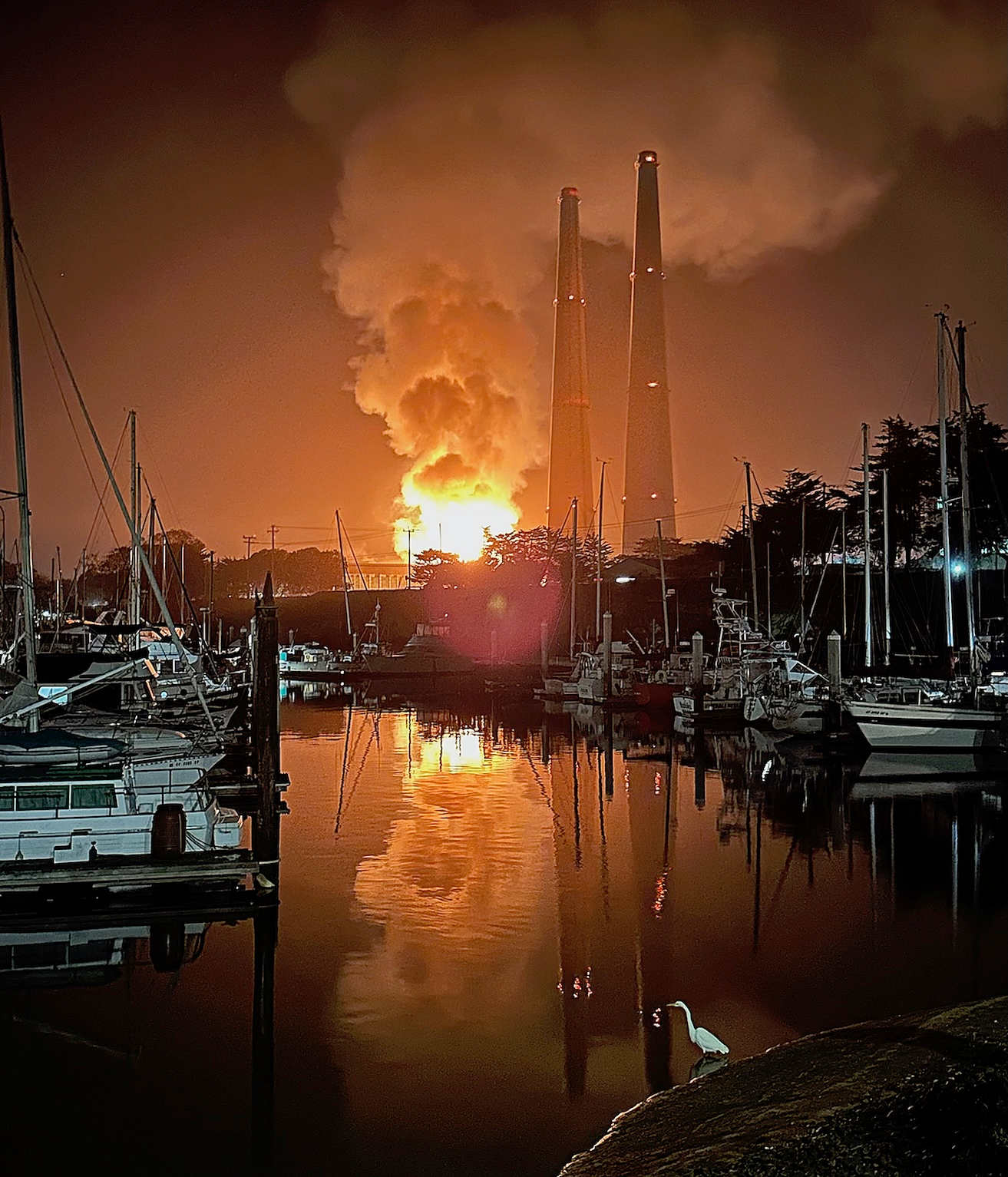
A year and a half after the massive battery fire at the Moss Landing Power Plant, a final environmental assessment concludes that off-site soil, sediment and surface water sampled around the facility do not appear to pose an unacceptable long-term risk to people or wildlife.
The report, prepared by Terraphase Engineering on behalf of Vistra Corp., found that concentrations of metals and other chemicals associated with the Jan. 16, 2025 fire were below levels that would warrant additional investigation or cleanup at the locations that were tested.
The Monterey County Environmental Health Bureau released the report Wednesday along with reviews from three state agencies.
County officials stressed that the Environmental Health Bureau served only as a coordinator of the public review process and did not independently verify the report or adopt its conclusions. Any future cleanup, monitoring or enforcement decisions will be made by state regulatory agencies.
Terraphase evaluated soil collected from 27 locations within a 10-mile radius of the plant, along with sediment, surface water and pore water from five environmentally sensitive areas near Elkhorn Slough.
Using conservative screening methods, the consultants concluded that cumulative cancer risks and non-cancer health hazards were below California risk management thresholds. They also found no evidence of long-term ecological risks in the sampled areas, with the exception of elevated nickel levels in portions of Hester Marsh and the Mosquito Abatement Observation Area, which the report attributes to naturally occurring background conditions rather than the fire.
The report therefore recommends no further off-site investigation or response actions for the sampled soil, sediment and surface water.
But regulators reviewing the document said the conclusions should be interpreted cautiously.
The Office of Environmental Health Hazard Assessment said it disagrees with Terraphase’s conclusion that elevated nickel concentrations in sediment at the Mosquito Abatement Observation Area represent natural background conditions. The agency also said the four- to nine-month delay before sampling began should have been identified as a significant limitation because contaminants may have been redistributed by wind and rain before testing occurred.
OEHHA further said it does not believe the report’s conclusion of “no ecological risks” can be stated as strongly because of uncertainties surrounding background nickel concentrations, documented losses of aquatic life after the fire and the delay in sampling. The agency recommended additional monitoring of aquatic invertebrates in the Mosquito Abatement Observation Area and Hester Marsh to determine whether the ecosystem has recovered.
The Department of Toxic Substances Control said the revised report contains “meaningful improvements,” including a better discussion of early air monitoring, transient deposition and the report’s limited scope.
However, DTSC said several ecological questions remain unresolved, including whether special-status species were adequately evaluated and whether additional follow-up is needed regarding observed impacts on aquatic life.
DTSC also said the report should more fully consider how contaminants deposited after the fire may have been redistributed through rainfall, runoff and tidal movement.
The Central Coast Regional Water Quality Control Board agreed that the report appropriately identifies remaining uncertainties involving groundwater, watershed transport and redistributed contaminants, while emphasizing that those issues are already being addressed through separate regulatory orders requiring Vistra to investigate on-site and off-site impacts.
County officials likewise cautioned that the report should not be viewed as the final word on the broader environmental impacts of the fire.
They noted that questions remain about potential exposures during and immediately after the blaze, movement of contaminants through the watershed, long-term biological effects and future environmental monitoring. Those issues, the county said, will be addressed through separate regulatory and scientific processes rather than this report.
The Jan. 16, 2025 fire destroyed roughly 55% of nearly 99,000 lithium-ion battery modules housed in one of the facility’s storage buildings, prompting evacuations of about 1,200 nearby residents and months of environmental monitoring.