
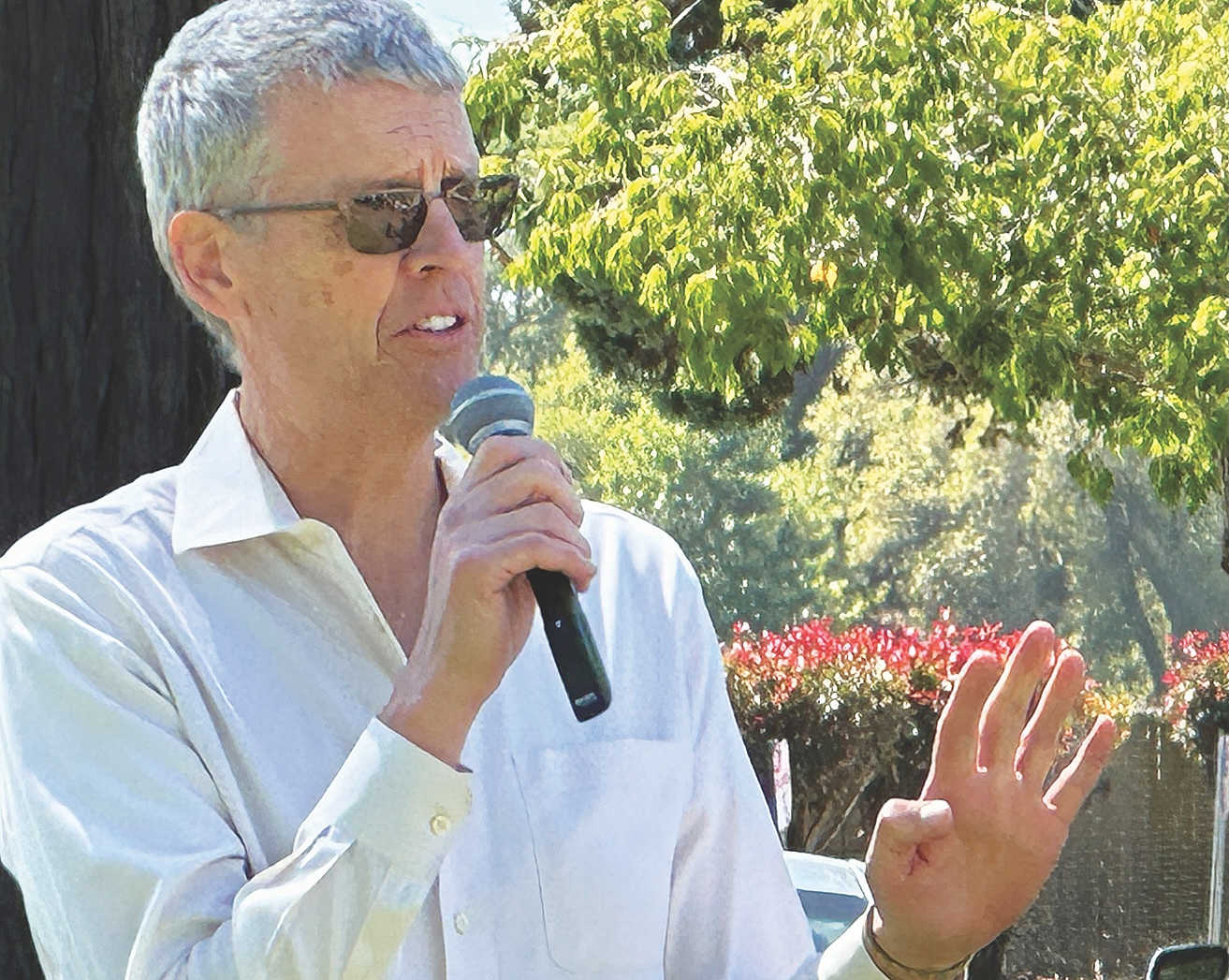
Around 150 people gathered June 28 at Pinto Lake City Park to learn of the next steps on a proposed Battery Energy Storage System (BESS) in Watsonville from Executive Director of the California Energy Commission, Drew Bohan.
The public meeting, hosted by Stop Lithium BESS in Santa Cruz, featured several guest speakers and members of the public who addressed concerns about what organizers described as “the proposed hazardous, flammable, explosive BESS right next to homes at 90 Minto Road.”
The project on Minto Road, a short distance from Pinto Lake, was proposed in January 2025 by Massachusetts-based New Leaf Energy. The CEC is the lead agency reviewing New Leaf’s application and will be the deciding factor in whether a BESS can be built at 90 Minto Road.
Back in May New Leaf Energy said it will bypass Santa Cruz County’s permitting process and instead seek state approval for its storage system.
In a May 1 letter to the county, the company said it would withdraw its application for the Seahawk project at 90 Minto Road and pursue the California Energy Commission’s “opt-in” permitting process under Assembly Bill 205.
“Your voice matters; don’t ever let anyone tell you it doesn’t matter,” local activist Becky Steinbruner told the crowd. “The ordinance that was written was severely flawed. We need to demand that the ordinance prohibit any BESS facility on agricultural land.”
Protesters are calling for a buffer zone of 1,000 meters between the facility and residents, schools, daycare centers and care facilities.
“This project was filed on June 8th,” Bohan said. “My staff and I have 30 days to determine whether the project is complete.” Bohan went on to explain that his team welcomes all input.
“Every comment that gets filed gets published in what we call the docket,” he said. He added that the file is typically not complete and involves a “back-and-forth process” that can take 10 or 11 months.
Once the project is complete, Bohan said he and his bosses will come to Watsonville and interview the community formally after presenting their findings about the application.
In a statement provided to The Pajaronian, New Leaf Project Lead Max Christian said that the project will meet or exceed the safety regulations included in Santa Cruz County’s draft BESS ordinance, which he described is “the strongest ordinance in the U.S., if not the world.”
Christian said that the project will include approximately 200 double-walled steel, sealed containerized batteries that will use lithium-iron phosphate (LFP) chemistry, as opposed to the more volatile, heavy-metal lithium-ion nickel-manganese-cobalt (NMC) chemistry that was used in first-generation systems like Moss Landing.
Much of the concern stems from the Jan. 16, 2025 fire at the Moss Landing Vistra Power Plant that led to hazardous toxic fallout and a thermal runaway at the edge of the Monterey Bay Sanctuary and ignited concern in Monterey and Santa Cruz counties about battery storage systems.
Santa Cruz County Supervisor elect Tony Nuñez offered words as well about assuring safety for the community.
“Public safety is what I ran on,” he said.
Organizers said the incumbent supervisor, Felipe Hernandez, was invited but was not present.
Scores of people expressed concern about why a BESS plant was being considered in a tightly packed residential area on the narrow Minto Road with one way in and out, and about lack of appropriate training for firefighters should a fire erupt inside the facility. Appropriate evacuation routes and centers were also discussed.
To file a comment, go to efiling.energy.ca.gov/Ecomment